
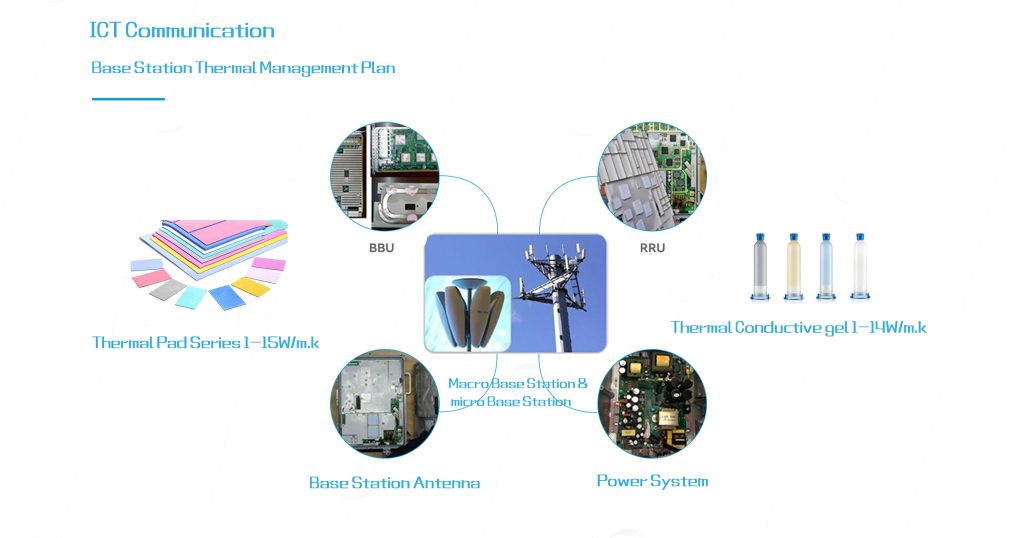
With the global deployment of 5G networks and the evolution towards 6G, communication base stations face increasingly challenging thermal management requirements. Higher frequencies, increased power output, and greater component density have made efficient heat dissipation critical for maintaining signal quality, ensuring network reliability, and extending equipment lifespan. This article explores how thermal pads and thermal gel provide comprehensive thermal solutions for modern communication base stations.
Thermal Challenges in Communication Base Stations
Modern base stations incorporate multiple heat-generating components:
- Power amplifiers (PAs) and RF components
- Baseband processing units
- Antenna array systems
- Power supply and conversion modules
These components operate in diverse environmental conditions while maintaining strict performance requirements. Inadequate thermal management can lead to:
- Signal degradation and output power reduction
- Component failure and reduced service life
- Network downtime and increased maintenance costs
Key Materials for Base Station Thermal Management
Thermal Pads: Reliable Performance for Diverse Applications
Thermal pads serve as the fundamental thermal interface material in base station design:
Application Scenarios:
- Between power amplifier modules and heat spreaders
- On baseband processing chips with moderate height variations
- For power supply components requiring electrical isolation
- On antenna array interfaces with consistent gap dimensions
Technical Advantages:
- Consistent performance over wide temperature ranges (-45°C to 150°C)
- Excellent dielectric strength and electrical insulation
- Minimal compression set for long-term reliability
- Easy installation and maintenance for field applications
Thermal Gel: Precision Thermal Solutions for Complex Assemblies
Thermal gel addresses challenging thermal interface requirements in advanced base station designs:
Critical Applications:
- Multi-height component arrays in RF units
- Irregular surfaces in custom power modules
- High-power density areas with minimal gap tolerance
- Components requiring maximum thermal performance
Performance Benefits:
- Ultra-low thermal resistance through perfect surface conformity
- Automatic dispensing compatibility for manufacturing efficiency
- Excellent stability under thermal cycling conditions
- Superior performance in vibration-prone environments
Implementation Strategies for Base Station Design
Macro Base Stations:
Thermal pads typically serve as the primary TIM for power amplifiers and processing units, providing reliable performance with straightforward installation. The material’s resilience ensures consistent thermal performance throughout the equipment’s operational lifespan.
Small Cell Applications:
Thermal gel becomes increasingly valuable in compact small cell designs where space constraints and component density create complex thermal challenges. The material’s flow characteristics enable optimal thermal interface formation in tightly packed assemblies.
Massive MIMO Systems:
Advanced antenna systems benefit from a hybrid approach, combining thermal pads for standardized components and thermal gel for customized thermal paths. This strategy optimizes both manufacturing efficiency and thermal performance.
Material Selection Considerations
Environmental Factors:
- Outdoor installations require materials with UV resistance and environmental sealing
- Temperature cycling capability from -40°C to 85°C
- Resistance to moisture, dust, and corrosive atmospheres
Performance Requirements:
- Thermal conductivity ranging from 1.5 W/m·K to 8.0 W/m·K
- Low thermal resistance for high heat flux applications
- Long-term stability under continuous operation
Manufacturing Considerations:
- Compatibility with automated assembly processes
- Repairability and maintenance requirements
- Total cost of ownership analysis
Conclusion
The successful thermal management of communication base stations requires careful selection and application of thermal interface materials. Thermal pads provide reliable, cost-effective solutions for standard applications, while thermal gel offers superior performance for challenging thermal environments. As base station technology continues to evolve, the strategic implementation of these materials will remain essential for ensuring network reliability and performance.
By understanding the specific requirements of each base station component and selecting the appropriate thermal interface material, manufacturers can optimize thermal performance while maintaining manufacturing efficiency and cost-effectiveness.