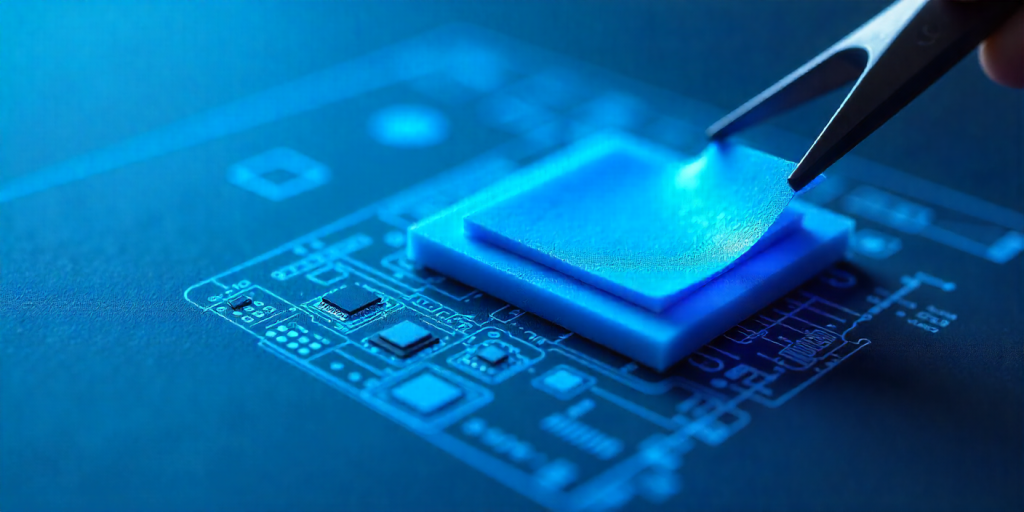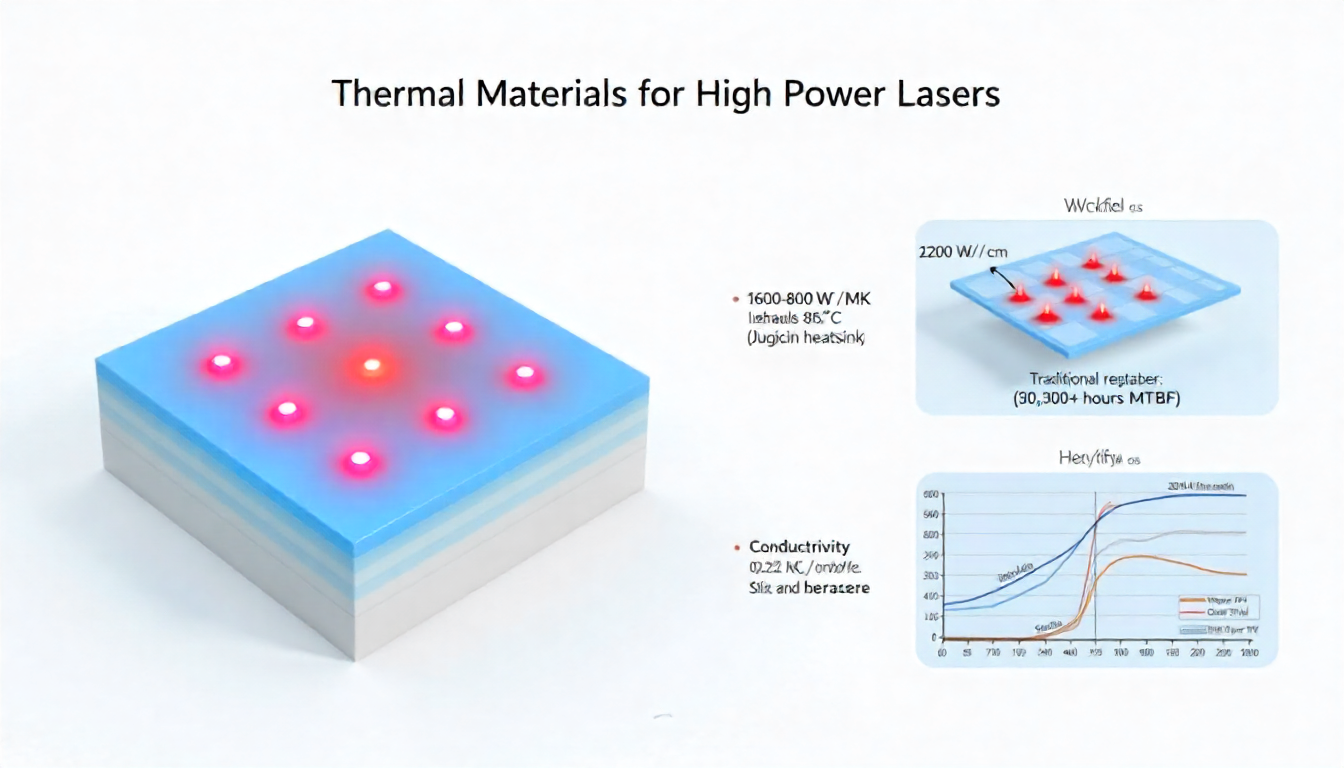
High-power laser systems and directed energy applications present unique thermal management challenges characterized by extremely high heat fluxes (often exceeding 1 kW/cm²) and stringent requirements for long-term stability under cyclic thermal loading. This research presents advanced metal matrix composite (MMC) thermal interface materials specifically engineered for these demanding applications, demonstrating their capability to address thermal bottlenecks in next-generation laser diode arrays and high-energy optical systems.
The High-Power Laser Thermal Challenge
Laser systems operating at multi-kilowatt power levels generate heat densities that exceed the capabilities of conventional thermal interface materials:
- Extreme Heat Flux Management: Laser diode bars and arrays generate heat fluxes ranging from 500-2000 W/cm², requiring thermal interface materials with effective thermal conductivities exceeding 100 W/m·K to maintain acceptable junction temperatures.
- Thermal Cycling Endurance: Pulsed laser operation creates rapid temperature fluctuations (often 50-100°C within milliseconds) that accelerate material degradation through thermal fatigue mechanisms.
- Optical Alignment Stability: Thermal interface materials must maintain dimensional stability to prevent optical misalignment, with thermal expansion coefficients closely matched to semiconductor and optical materials.
- Long-Term Reliability: Industrial and defense applications require materials that maintain performance for thousands of hours under continuous or pulsed operation without degradation.
Material Innovation: Nano-Enhanced Metal Matrix Composites
Our research focuses on copper and aluminum matrix composites with controlled nanostructure:
Diamond-Reinforced Copper Composites: We develop copper-diamond composites with 55-65% diamond volume fraction, achieving thermal conductivity of 600-800 W/m·K while maintaining coefficient of thermal expansion (CTE) of 6-8 ppm/°C. Interface engineering using titanium and chromium coatings reduces thermal boundary resistance by 70% compared to uncoated diamond particles.
Graphene-Aluminum Laminates: We create alternating layers of aluminum and aligned graphene sheets, achieving in-plane thermal conductivity exceeding 400 W/m·K while providing exceptional mechanical strength and CTE control (8-10 ppm/°C).
Functionally Graded Structures: We engineer materials with spatially varying compositions to optimize thermal and mechanical properties across the interface, reducing stress concentrations and improving reliability under thermal cycling.
Manufacturing Processes
Advanced fabrication techniques enable practical implementation:
Spark Plasma Sintering: We utilize SPS for rapid consolidation of composite powders, achieving near-theoretical density while minimizing interfacial reactions that degrade thermal properties.
Additive Manufacturing: Laser powder bed fusion enables fabrication of complex geometries with controlled porosity and composition gradients, optimized for specific cooling channel configurations.
Precision Bonding: We develop low-temperature bonding techniques using transient liquid phase sintering, enabling integration with temperature-sensitive optical components.
Performance Validation in Laser Systems
Testing in industrial and defense laser systems demonstrates exceptional performance:
High-Power Diode Laser Arrays:
- Heat flux handling: Sustained operation at 1200 W/cm² with junction temperatures below 85°C
- Thermal resistance: 0.02-0.03 K·cm²/W at operational interfaces
- Lifetime: Projected MTBF exceeding 50,000 hours under typical operating conditions
- Power efficiency: System wall-plug efficiency improved by 8-12% compared to conventional cooling approaches
Fiber Laser Pump Sources:
- Temperature stability: Maintained ±0.5°C temperature uniformity across 100-emitter arrays
- Reliability: Zero failures attributed to thermal interface materials in 20,000-hour accelerated testing
- Maintenance reduction: Eliminated need for periodic TIM replacement in industrial systems
Directed Energy Systems:
- Peak power handling: Demonstrated capability for 10-second bursts at 5 kW/cm²
- Thermal cycling: Survived 100,000 cycles between 25°C and 150°C without performance degradation
- Environmental resistance: Maintained performance under MIL-STD-810 environmental conditions
Comparative Analysis
MMC materials show significant advantages:
vs. Thermal Greases and Pastes:
- 10-20x higher thermal conductivity
- No pump-out or drying issues
- Superior long-term stability
vs. Phase Change Materials:
- Higher maximum operating temperatures (300°C+ vs. 150°C)
- Better mechanical strength and dimensional stability
- Lower thermal resistance at high pressures
vs. Graphite Foils:
- Higher through-plane conductivity
- Better conformability to rough surfaces
- Superior electrical isolation capabilities
Future Development Pathways
Ongoing research addresses emerging requirements:
Active Cooling Integration: Developing materials with embedded microfluidic channels for combined conductive and convective cooling.
Smart Thermal Interfaces: Incorporating shape memory alloys or phase change components for adaptive thermal resistance control.
Radiation-Hardened Composites: Formulations optimized for space-based laser applications with enhanced radiation resistance.
Sustainable Manufacturing: Developing recycling processes for rare and expensive components like diamond and graphene.
Economic and Strategic Impact
MMC thermal interface materials enable significant advancements:
Commercial Applications: Enable higher power densities and improved reliability in industrial lasers for manufacturing, medical systems, and telecommunications.
Defense Applications: Support development of next-generation directed energy weapons with improved power output and reliability.
Scientific Research: Facilitate higher performance in experimental laser systems for physics research and materials processing.
Conclusion
Metal matrix composite thermal interface materials represent a critical enabling technology for high-power laser systems, addressing fundamental thermal limitations while supporting requirements for reliability, efficiency, and performance. As laser technology continues to advance toward higher powers and new applications, these advanced materials will play an increasingly important role in thermal management solutions, supporting innovation across industrial, scientific, and defense sectors.