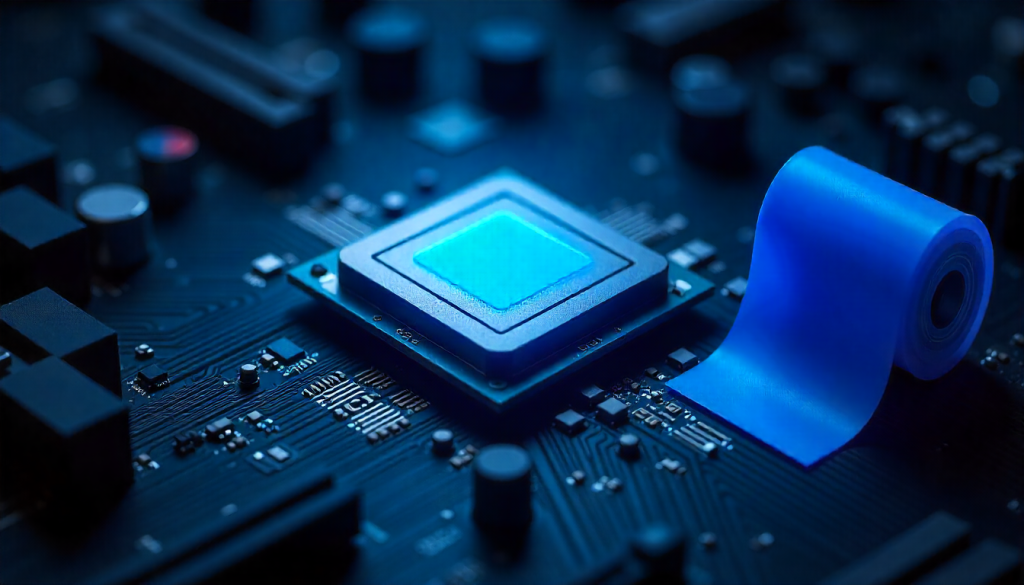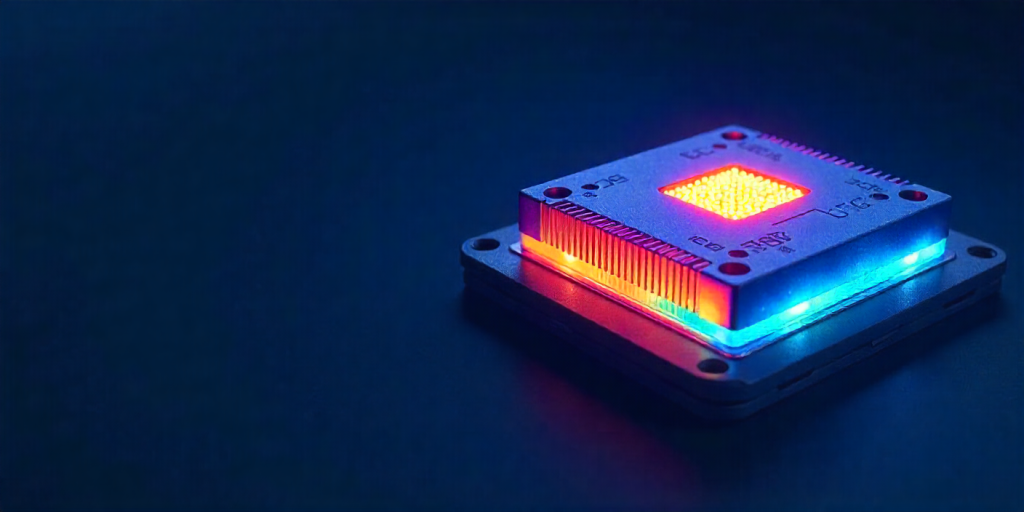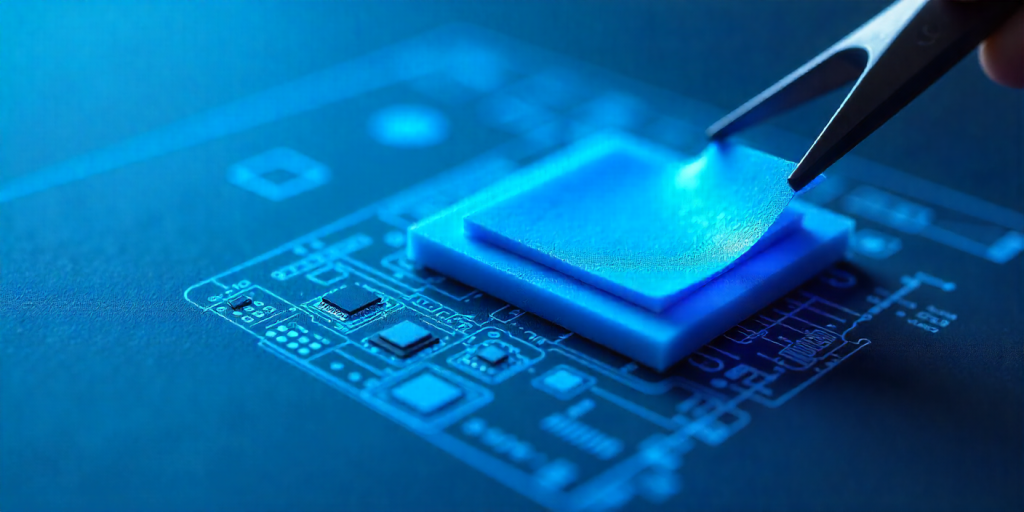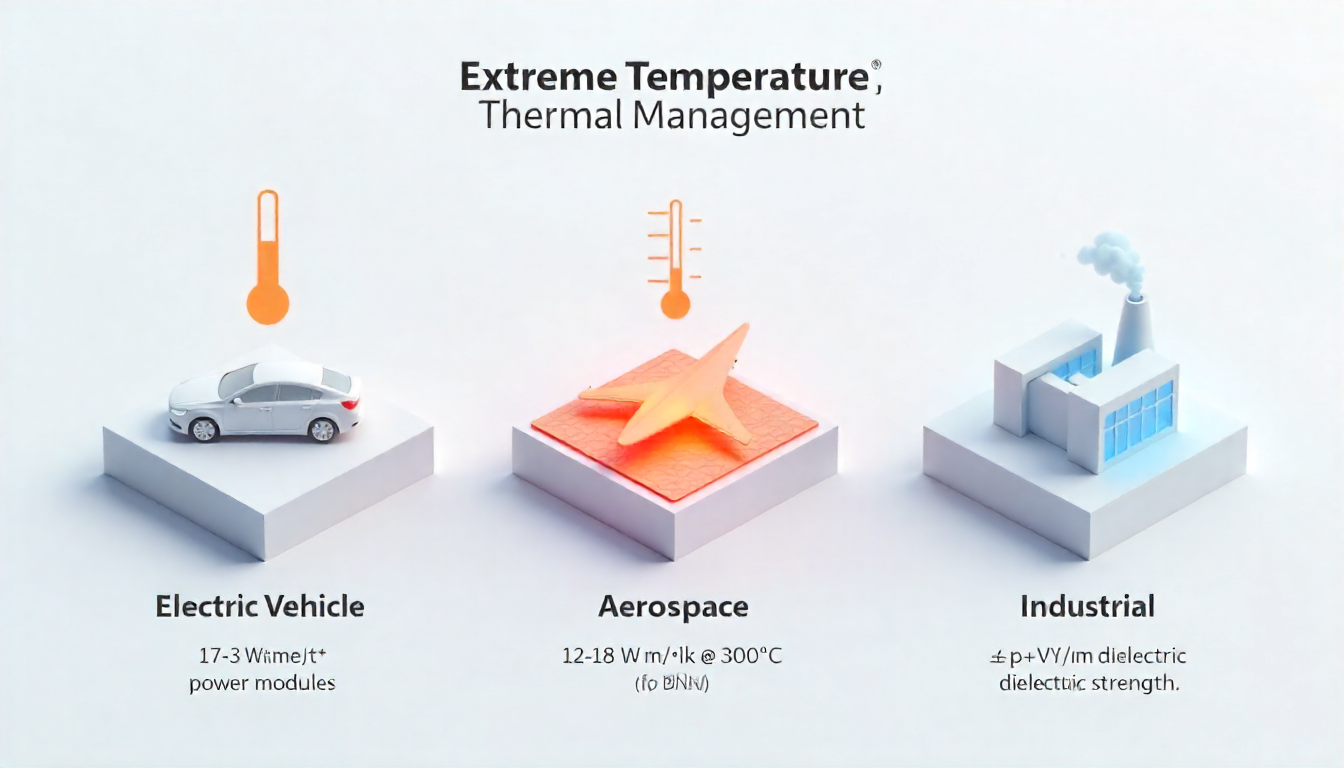
The increasing operating temperatures of power electronics, particularly in automotive, aerospace, and industrial applications, have created demand for thermal interface materials capable of sustained operation above 200°C while maintaining excellent thermal and electrical properties. This research presents a comprehensive study of boron nitride nanotube (BNNT) based thermal interface materials engineered for extreme temperature applications, examining their performance advantages over conventional materials and their potential to enable next-generation high-temperature power systems.
The High-Temperature Power Electronics Challenge
Power electronics operating at elevated temperatures present unique material challenges:
- Material Stability: Conventional polymer-based thermal interface materials degrade rapidly above 150°C, suffering from oxidation, cross-linking, and eventual decomposition that compromises thermal performance and mechanical integrity.
- Thermal Conductivity Requirements: Power devices operating at high temperatures require exceptional thermal interface materials to maintain acceptable junction temperatures, with thermal conductivity targets exceeding 10 W/m·K at operating temperatures up to 300°C.
- Electrical Isolation: High-temperature operation increases the risk of dielectric breakdown, requiring materials with exceptional electrical insulation properties maintained across the entire operating temperature range.
- Thermal Cycling Endurance: Applications such as electric vehicle inverters and aircraft power systems experience rapid temperature fluctuations that accelerate material fatigue and degradation.
Material Innovation: BNNT-Based Composites
Boron nitride nanotubes offer unique advantages for high-temperature applications:
Intrinsic Material Properties: BNNTs combine high thermal conductivity (theoretical >3000 W/m·K for individual nanotubes), excellent electrical insulation (bandgap ~6 eV), and exceptional thermal stability (stable in air up to 900°C). Our research focuses on harnessing these properties in practical composite materials.
Nanotube Alignment and Dispersion: We developed proprietary processing techniques that achieve uniform BNNT dispersion in ceramic and high-temperature polymer matrices while controlling alignment to optimize through-plane thermal conductivity. Our materials achieve alignment factors exceeding 80% in the thickness direction.
Interface Engineering: We functionalize BNNT surfaces with organosilane groups that improve compatibility with matrix materials while maintaining the nanotubes’ intrinsic thermal properties. This approach reduces interfacial thermal resistance by approximately 70% compared to untreated nanotubes.
Matrix Material Development: We engineer ceramic-polymer hybrid matrices that combine the processability of polymers with the thermal stability of ceramics. These matrices maintain mechanical integrity up to 350°C while providing excellent adhesion to power device surfaces.
Manufacturing and Processing
Our scalable manufacturing approach enables commercial production:
Continuous BNNT Synthesis: Using high-temperature plasma methods, we produce BNNTs with controlled diameter (20-50 nm) and length (5-20 μm) distributions optimized for thermal interface applications.
Composite Fabrication: We employ solution casting and hot pressing techniques to produce uniform composite sheets with thicknesses from 25μm to 500μm, suitable for various power packaging configurations.
Integration Processes: Our materials are compatible with standard power electronics assembly processes, including solder reflow and epoxy curing, without degradation of thermal or electrical properties.
Performance Characterization
Extensive testing confirms the exceptional properties of BNNT thermal interface materials:
High-Temperature Thermal Conductivity:
- Through-plane conductivity: 12-18 W/m·K from 25°C to 300°C
- Less than 15% degradation in thermal conductivity after 1,000 hours at 250°C
- Thermal resistance: 0.08-0.12 K·cm²/W at typical application thicknesses
Electrical Properties:
- Dielectric strength: >300 V/μm maintained up to 300°C
- Volume resistivity: >10¹⁵ Ω·cm at 250°C
- Dielectric constant: 3.5-4.2 with low frequency and temperature dependence
Mechanical and Reliability Performance:
- Coefficient of thermal expansion: 8-12 ppm/°C, well-matched to power semiconductor materials
- Shear strength: 25-40 MPa maintained after 500 thermal cycles (25°C to 250°C)
- No observable degradation after 5,000 hours at 200°C in controlled atmosphere
Application Case Studies
Electric Vehicle Traction Inverters:
Implementation in 800V silicon carbide inverters demonstrated:
- Temperature Management: Junction temperatures reduced by 35°C during peak power operation
- Power Density: Enabled 25% increase in power density while maintaining thermal margins
- Reliability: Zero thermal interface-related failures in 100,000 km equivalent testing
- Efficiency: System efficiency improved by 1.2% at rated power due to reduced thermal losses
Aerospace Power Systems:
Testing in aircraft motor controllers showed:
- High-Temperature Operation: Stable performance during sustained operation at 225°C
- Vibration Resistance: Maintained thermal performance through MIL-STD-810 vibration testing
- Weight Reduction: 40% reduction in thermal management system weight compared to conventional solutions
- Lifetime: Projected service life exceeding 50,000 hours at rated conditions
Industrial Motor Drives:
Application in high-power industrial drives demonstrated:
- Continuous Operation: No performance degradation after 10,000 hours at 180°C
- Maintenance Reduction: Eliminated need for thermal interface material replacement during equipment service intervals
- Energy Savings: Reduced cooling energy consumption by approximately 15%
Comparative Analysis
BNNT materials show significant advantages over alternatives:
vs. Conventional Silicone-Based Materials:
- 3-5x higher thermal conductivity at elevated temperatures
- 10x longer service life at 200°C
- Superior resistance to thermal cycling and mechanical stress
vs. Ceramic-Filled Composites:
- Better mechanical compliance and interface conformity
- Lower thermal resistance at thin bond lines
- Improved processability and integration
vs. Graphite-Based Materials:
- Superior electrical insulation properties
- Better oxidation resistance
- More consistent performance across temperature ranges
Future Development Directions
Ongoing research focuses on several promising areas:
Hybrid Nanostructures: Combining BNNTs with other nanomaterials (graphene, diamond nanoparticles) to create materials with tailored anisotropic properties.
Functional Gradients: Developing materials with spatially varying properties to optimize performance for specific thermal and mechanical stress distributions.
Self-Healing Formulations: Incorporating reversible chemical bonds for materials that can repair minor damage during operation.
Sustainable Manufacturing: Developing more energy-efficient production methods and exploring bio-derived matrix materials.
Economic and Environmental Considerations
BNNT thermal interface materials offer compelling value:
Economic Benefits:
- Extended product lifetimes reducing replacement costs
- Improved system efficiency lowering operating costs
- Reduced cooling system requirements decreasing initial equipment costs
Environmental Benefits:
- Energy savings from improved thermal management
- Reduced material consumption through extended service life
- Potential for recycling and recovery of valuable materials
Conclusion
Boron nitride nanotube thermal interface materials represent a significant advancement for high-temperature power electronics, addressing critical limitations of conventional materials while enabling higher power densities, improved reliability, and extended operating temperatures. As power electronics continue to push temperature boundaries in applications ranging from electric vehicles to renewable energy systems, these advanced materials will play an increasingly important role in managing thermal challenges while meeting stringent performance and reliability requirements. Their development exemplifies how nanotechnology can provide practical solutions to real-world engineering challenges in power electronics thermal management.