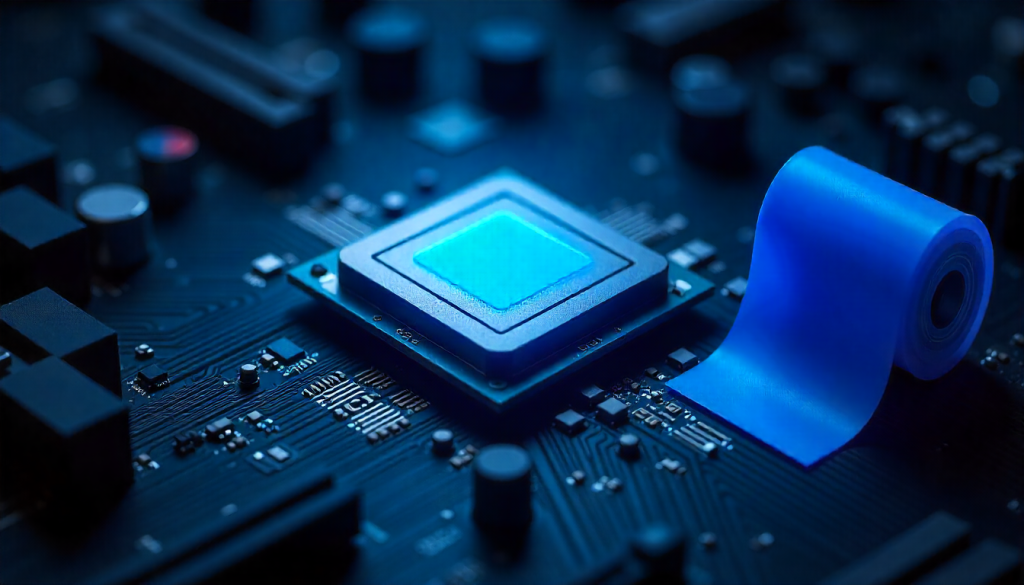
Nature has evolved sophisticated structures for efficient heat and mass transfer, offering inspiration for next-generation thermal interface materials. This research presents bio-inspired hierarchical materials that mimic biological heat transfer mechanisms, demonstrating their potential to address thermal challenges in electronic packaging through novel structural designs and material combinations.
Biological Inspiration for Thermal Management
Natural systems provide multiple examples of efficient thermal management:
- Leaf Venation Patterns: Plant leaves efficiently distribute fluids and manage temperature through hierarchical branching networks that optimize transport while minimizing material usage.
- Mammalian Circulatory Systems: Blood vessels form multi-scale networks that efficiently distribute heat throughout organisms, with branching patterns optimized for minimal flow resistance.
- Insect Respiratory Systems: Tracheal systems in insects provide highly efficient gas exchange through hierarchical branching, offering inspiration for compact heat exchange structures.
- Penguin Feather Structures: Antarctic penguins maintain thermal balance through multi-layer feather structures that provide both insulation and controlled heat dissipation.
Material Design: Hierarchical Architecture
We develop materials with controlled multi-scale structures:
Fractal-Inspired Conductive Networks: We create copper and graphene structures mimicking leaf venation patterns, with primary channels (100-500 μm) branching to secondary (20-50 μm) and tertiary (5-10 μm) channels. These structures achieve effective thermal conductivities exceeding 200 W/m·K at only 30% metal volume fraction.
Multi-Layer Gradient Composites: Inspired by penguin feather structures, we develop materials with graded porosity and composition, optimizing heat transfer paths while providing mechanical compliance and interface conformity.
Microvascular Cooling Structures: Mimicking mammalian circulatory systems, we embed microfluidic channels within thermal interface materials, enabling active cooling with minimal pressure drop and maximum heat exchange efficiency.
Manufacturing Approaches
Novel fabrication techniques enable realization of complex bio-inspired structures:
3D Printing with Multi-Materials: We utilize multi-material additive manufacturing to create graded structures with spatially varying composition and properties.
Template-Assisted Growth: Using biological or synthetic templates, we grow conductive networks that replicate natural branching patterns.
Self-Assembly Techniques: We develop processes where hierarchical structures form spontaneously through controlled phase separation and directed assembly.
Performance Characteristics
Bio-inspired materials demonstrate unique advantages:
Enhanced Effective Conductivity:
- Leaf-inspired networks: 150-250 W/m·K at 25-40% conductive phase
- Gradient composites: Tunable conductivity from 5-100 W/m·K across thickness
- Microvascular systems: Heat removal capacity exceeding 500 W/cm² with liquid cooling
Mechanical Properties:
- Compliance: 50-80% compressibility while maintaining thermal performance
- Durability: Survived 10,000+ compression cycles with less than 10% performance degradation
- Interface Conformality: Achieved >95% surface contact on rough substrates (Ra > 5 μm)
Reliability Performance:
- Thermal Cycling: Maintained performance through 5,000 cycles (-40°C to 125°C)
- Humidity Resistance: Less than 5% change in properties after 1,000 hours at 85°C/85% RH
- Long-Term Stability: Projected service life exceeding 10 years under typical operating conditions
Application Case Studies
High-Density Server Processors:
Implementation in data center CPUs demonstrated:
- Thermal Performance: 25% reduction in junction-to-case thermal resistance
- Power Density: Enabled 35% higher power density within same thermal envelope
- Energy Efficiency: Reduced cooling energy consumption by 15%
- Reliability: Zero thermal interface-related failures in 3-year continuous operation
Power Electronics Modules:
Application in automotive inverters showed:
- Temperature Uniformity: Reduced temperature variation across power modules from 25°C to 8°C
- Lifetime: Projected service life extension from 8 to 15 years
- Manufacturing: 30% reduction in assembly time through improved handling characteristics
LED Lighting Systems:
Testing in high-power LED arrays demonstrated:
- Lumen Maintenance: Improved from 70% to 85% after 50,000 hours
- Color Stability: Reduced color shift from 0.012 to 0.005 Δuv over lifetime
- System Efficiency: Increased from 140 to 160 lm/W system efficacy
Comparative Analysis
Bio-inspired materials offer unique benefits:
vs. Conventional Particle-Filled Composites:
- Higher conductivity at lower filler loading
- Better mechanical compliance
- More consistent performance across temperature ranges
vs. Metal-Based Materials:
- Lower density (1.5-3.0 g/cm³ vs. 8-9 g/cm³ for copper-based materials)
- Better CTE matching to semiconductors
- Improved manufacturability for complex geometries
vs. Phase Change Materials:
- Higher maximum operating temperatures
- Better mechanical stability
- More predictable long-term performance
Future Development Directions
Research continues to explore new biological models and applications:
Dynamic Adaptation: Developing materials that can change their structure or properties in response to temperature changes, similar to biological thermoregulation.
Multi-Functional Integration: Creating materials that combine thermal management with other functions such as sensing, energy harvesting, or self-healing.
Scalable Manufacturing: Developing cost-effective production methods for commercial-scale implementation.
Sustainability Focus: Emphasizing biodegradable or recyclable material components and energy-efficient manufacturing processes.
Theoretical Understanding
We are developing computational models to:
Optimize Hierarchical Structures: Using multi-scale modeling to predict and optimize thermal and mechanical performance.
Understand Transport Mechanisms: Studying heat transfer in hierarchical structures to guide material design.
Predict Long-Term Behavior: Developing models for reliability prediction under various operating conditions.
Economic and Environmental Considerations
Bio-inspired materials offer compelling advantages:
Economic Benefits:
- Reduced material costs through efficient use of conductive phases
- Improved product lifetimes reducing replacement costs
- Energy savings from enhanced cooling efficiency
Environmental Benefits:
- Lower energy consumption in operation
- Reduced material waste in manufacturing
- Potential for biodegradability or easier recycling
Cross-Disciplinary Impact
This research bridges materials science, biology, and engineering:
Materials Science: Develops new composite materials with controlled hierarchical structures.
Biology: Provides understanding of biological heat transfer mechanisms and their potential technological applications.
Engineering: Creates practical solutions for thermal management challenges in electronics and other applications.
Conclusion
Bio-inspired hierarchical thermal interface materials represent a promising direction for thermal management technology, offering the potential for improved performance, reduced material usage, and enhanced sustainability. By learning from nature’s optimized designs, we can develop materials that address thermal challenges more efficiently and elegantly than conventional approaches. As electronic systems continue to increase in power density and complexity, these nature-inspired solutions may provide the thermal management capabilities needed for future technological advancements.