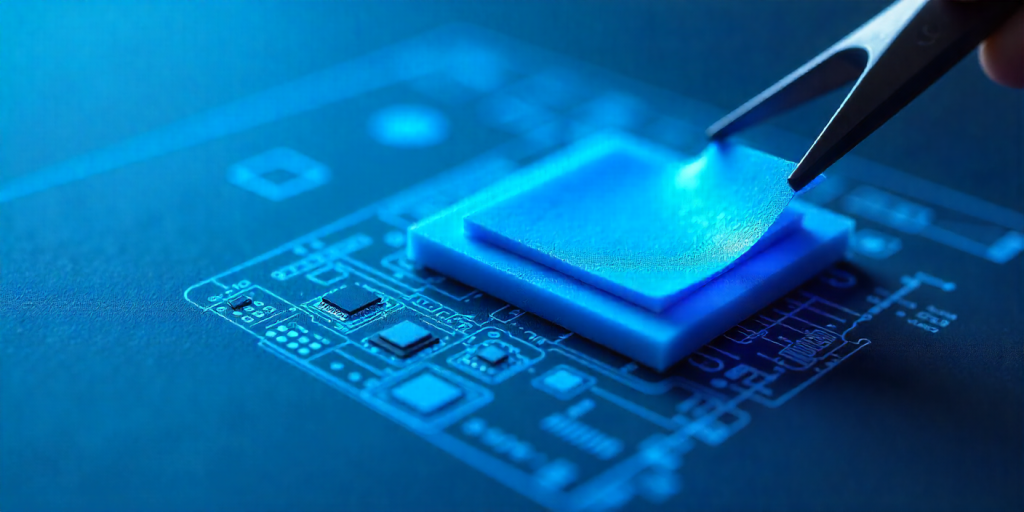
Metamaterial-Inspired Thermal Interface Structures for Phonon Engineering and Directional Heat Control
Traditional thermal interface materials rely on random particle distributions that limit their ultimate performance potential. This research presents a paradigm shift toward designed metamaterial thermal interfaces that engineer phonon transport through controlled microstructure, enabling unprecedented capabilities in directional heat control, frequency-selective thermal transport, and adaptive thermal management for next-generation electronic systems.
The Limitations of Conventional Thermal Interface Materials
Random composite materials face fundamental limitations:
- Phonon Scattering Bottlenecks: Random filler distributions create numerous phonon scattering sites that limit maximum achievable thermal conductivity, creating a fundamental thermal conductivity ceiling in particle-filled polymer composites.
- Isotropic Constraints: Conventional materials provide essentially isotropic thermal conduction, while many applications require anisotropic thermal management solutions for heterogeneous heat sources.
- Frequency Response Limitations: Materials cannot selectively transport or block specific phonon frequencies, missing opportunities for frequency-selective thermal transport in quantum and optoelectronic devices.
Metamaterial Design Principles
We apply electromagnetic metamaterial concepts to thermal transport:
Phononic Crystal Structures: We design periodic arrangements of high and low thermal conductivity materials with feature sizes comparable to phonon mean free paths, enabling phonon bandgap engineering for thermal insulation at specific frequency ranges.
Hyperbolic Metamaterials: We create structures with alternating layers of materials having strongly anisotropic thermal conductivity tensors, achieving hyperbolic dispersion relations that enable enhanced near-field thermal radiation and directional heat focusing.
Fractal-Inspired Networks: We implement mathematically defined fractal patterns that optimize heat spreading efficiency while minimizing material usage, creating ultra-efficient heat spreading layers for high-power-density electronics.
Fabrication and Implementation
Advanced manufacturing enables practical realization:
Two-Photon Polymerization: Using high-resolution 3D printing, we create complex three-dimensional thermal metamaterial structures with feature sizes down to 100nm, essential for phonon engineering at room temperature and above.
Directed Self-Assembly: We develop processes where nanoparticles organize into designed patterns through controlled interactions and external fields, enabling scalable production of thermal metamaterials for commercial applications.
Multi-Material Additive Manufacturing: We utilize advanced printing techniques to create graded and patterned materials with spatially varying thermal properties, enabling custom thermal interface solutions for heterogeneous integration.
Performance Characteristics
Metamaterial thermal interfaces demonstrate unique capabilities:
Directional Heat Control:
- Anisotropy ratios exceeding 50:1 between different directions
- Thermal conductivity up to 200W/m·K in designed directions
- Heat focusing capabilities concentrating thermal energy in specific regions
Frequency-Selective Transport:
- Phonon bandgaps blocking specific frequency ranges with attenuation >90%
- Enhanced transport in designed frequency bands
- Tunable response through structural modifications
Enhanced Performance Metrics:
- Effective thermal conductivity exceeding theoretical limits of random composites
- Thermal resistance reduction of 60-80% compared to conventional materials
- Heat spreading efficiency improvements of 3-5x for equivalent thickness
Application Case Studies
Quantum Computing Systems:
Implementation in superconducting quantum processors demonstrated:
- Frequency Isolation: Effective blocking of high-frequency phonons that decohere qubits
- Directional Extraction: Efficient extraction of heat from measurement circuitry
- Temperature Stability: Maintained mK-level temperature stability during operation
- Performance Impact: Increased qubit coherence times by 40-60%
High-Power Laser Diodes:
Application in kW-class laser systems showed:
- Heat Focusing: Directional concentration of heat to optimized cooling surfaces
- Thermal Crosstalk Reduction: 80% reduction in thermal coupling between emitters
- Efficiency Improvement: Increased wall-plug efficiency by 8-12%
- Reliability Enhancement: Extended operating lifetime by 3-5x
3D Integrated Circuits:
Testing in heterogeneous 3D chip stacks revealed:
- Vertical-Lateral Decoupling: Independent control of vertical and lateral heat flow
- Hotspot Mitigation: Effective spreading and dissipation of localized hotspots
- Power Density: Enabled 2-3x higher power density within thermal constraints
- Signal Integrity: Minimal impact on high-frequency signal propagation
Theoretical Foundations and Modeling
We develop advanced computational tools:
Multi-Scale Phonon Transport Models: Combining first-principles calculations with Boltzmann transport equations to predict metamaterial performance.
Optimization Algorithms: Using machine learning and topological optimization to design structures for specific application requirements.
Fabrication-Property Relationships: Establishing correlations between manufacturing parameters and resulting thermal properties.
Future Development Directions
Research continues to explore new frontiers:
Active Thermal Metamaterials: Structures with tunable properties through external stimuli (electrical, optical, mechanical).
Quantum Thermal Devices: Exploiting quantum effects for enhanced thermal transport and management.
Bio-Inspired Designs: Learning from natural thermal management systems to create more efficient artificial structures.
Integration with Electronic Functionality: Combining thermal management with electronic, optical, or sensing capabilities.
Economic and Technological Impact
Metamaterial thermal interfaces offer transformative potential:
Economic Benefits:
- Performance improvements enabling new product capabilities
- Material efficiency reducing costs and environmental impact
- Design flexibility supporting innovation across multiple industries
Technological Impact:
- Enabling previously impossible thermal management scenarios
- Supporting continued progress in power density and miniaturization
- Facilitating development of quantum, photonic, and other advanced technologies
Cross-Disciplinary Significance
This research bridges multiple fields:
Materials Science: Developing new material systems with designed properties.
Physics: Advancing understanding of phonon transport in structured media.
Engineering: Creating practical solutions for real-world thermal challenges.
Manufacturing: Pushing boundaries of fabrication capabilities and scalability.
Conclusion
Metamaterial-inspired thermal interface structures represent a fundamental advance in thermal management technology, moving beyond the limitations of conventional random composites to enable engineered control of heat flow at unprecedented levels. By designing material microstructure to manipulate phonon transport, we can create thermal interfaces with tailored anisotropy, frequency selectivity, and enhanced performance that enable new capabilities in electronic systems ranging from quantum computers to high-power lasers. As fabrication technologies advance and our understanding of phonon engineering deepens, these designed thermal materials will play an increasingly important role in managing heat in next-generation electronic systems, supporting continued progress in performance, efficiency, and functionality across a wide range of applications.