Calculating the Exact Energy Savings from an Optimized Thermal Interface
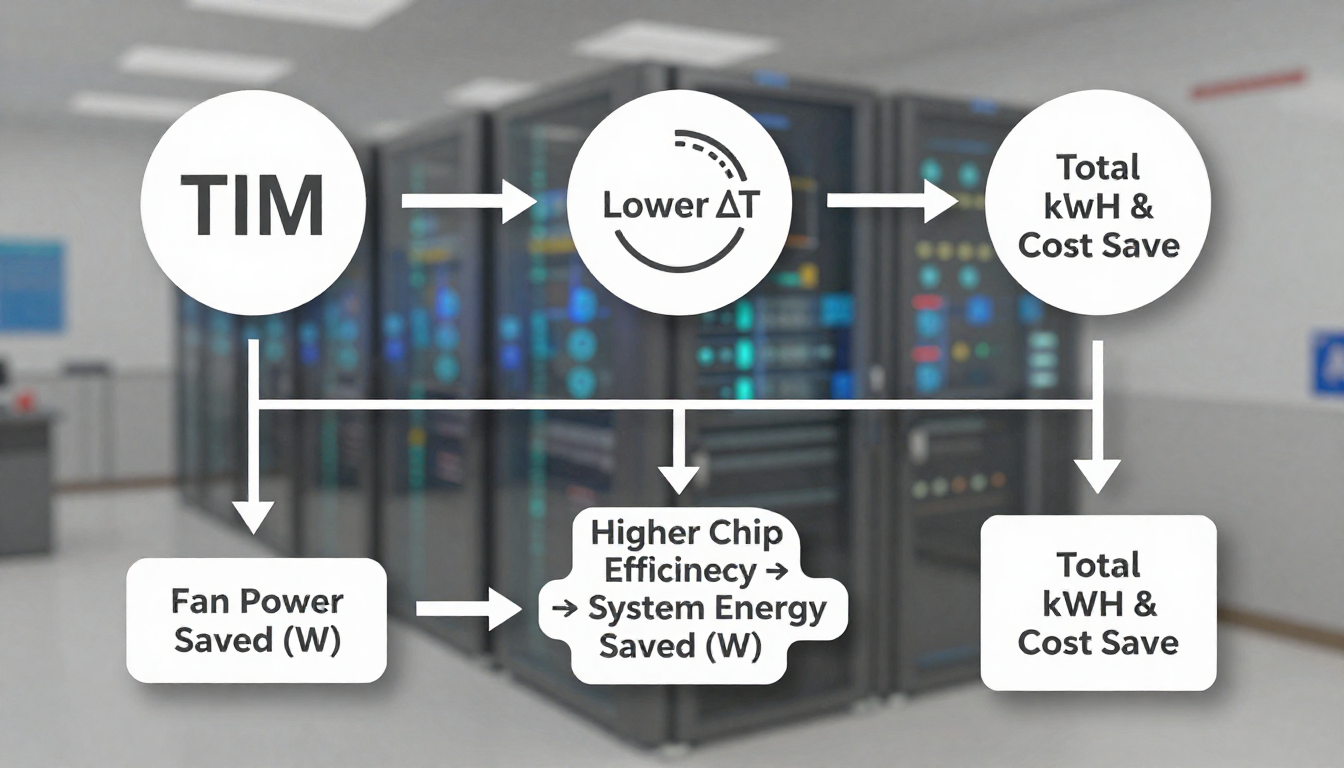
Discussions about Thermal Interface Material (TIM) performance often focus on degrees Celsius. To make a compelling business case, we must translate temperature deltas into watts, kilowatt-hours, and dollars. An optimized TIM doesn’t just run cooler; it saves measurable energy and cost.
The Translation Formula: From ΔT to ΔW
The principle is straightforward: a lower thermal resistance (θ) allows a heatsink to operate more efficiently. For a given heat load (Q), the temperature difference (ΔT) across the interface is: ΔT = Q × θ.
A reduction in θ (Δθ) directly reduces ΔT. This lower component temperature often allows for:
- Reduced Fan Power: Fan laws dictate that power consumption scales with the cube of speed. A lower ΔT can allow a lower fan RPM, resulting in significant parasitic power savings.
- Enhanced System Efficiency: In power electronics (e.g., EV inverters), semiconductor losses decrease at lower junction temperatures. A better TIM can directly improve the conversion efficiency, saving energy in the primary system itself.
A Practical Data Center Example:
假设一个服务器CPU的TDP为250W。将界面热阻降低0.05 °C/W,可将CPU温度降低 12.5°C (250W × 0.05°C/W)。这可以使冷却系统将风扇转速降低20%。对于一台典型服务器风扇,这可能意味着节约5-10W的持续功耗。在一个拥有10,000台服务器的数据中心,这相当于 500 kW to 1 MW 的持续节电,每年节省电费可达数十万美元,并直接改善PUE(电源使用效率)。
Making the Business Case:
When evaluating a TIM upgrade, model the cascading energy savings—not just the component temperature. The higher upfront cost of a premium, stable phase change material is often justified many times over by the reduced operational expenditure (OpEx) in energy-intensive applications.