The Lack of Universal Standards: Navigating the Inconsistent World of TIM Performance Data
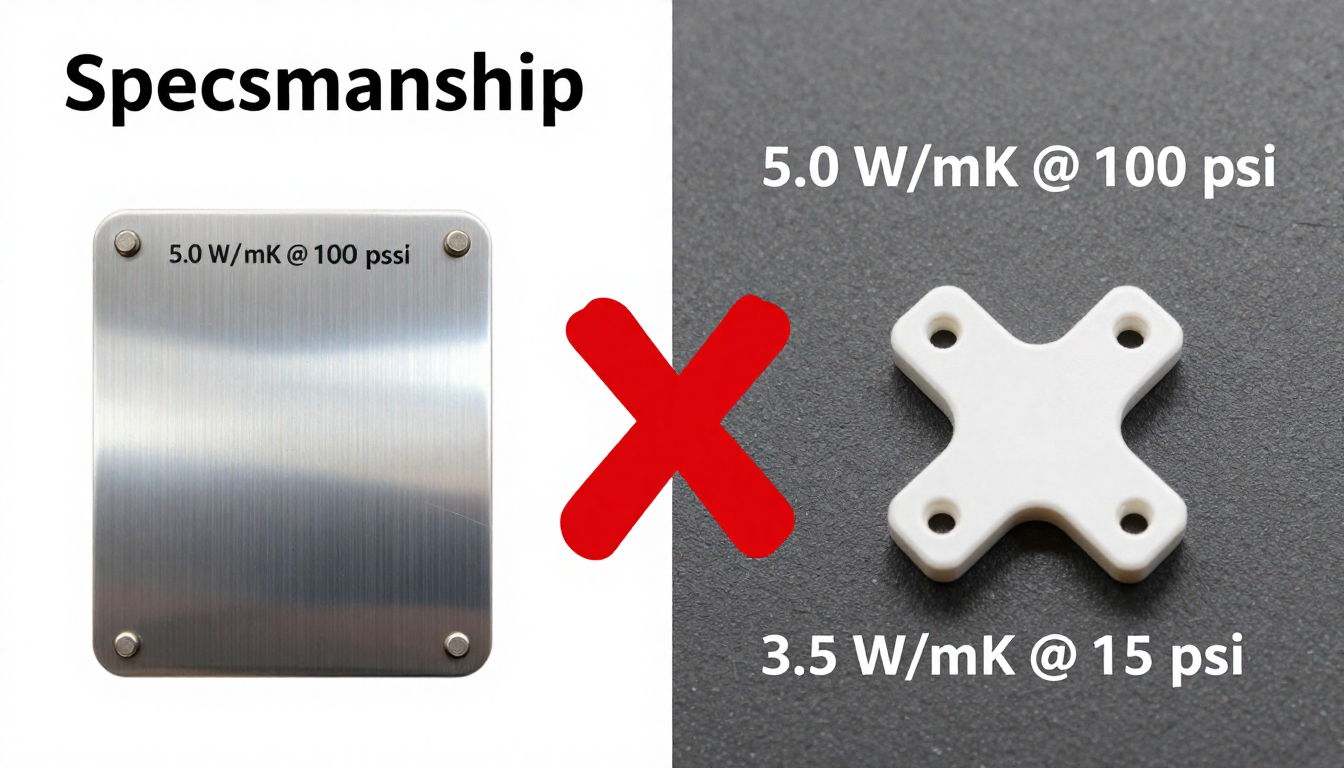
A common and costly pitfall in thermal design is directly comparing the thermal conductivity (k-value) of two TIMs from different suppliers. The stark truth is that without identical test conditions, these numbers are virtually meaningless. The industry lacks a universally enforced standard for reporting TIM data, leading to rampant “specsmanship.”
Where Does the Variability Come From?
- Test Method & Fixture (ASTM D5470 is a Framework, Not a Prescription): While many claim to use ASTM D5470, critical parameters are not fixed:
- Interface Pressure: Values can be reported at 10 psi, 50 psi, or 100 psi. A soft pad may look good at high pressure but terrible at low pressure. Always ask for a performance curve across a pressure range.
- Surface Finish & Flatness: A mirror-polished test surface yields a better (and often unrealistic) k-value than a rough cast surface.
- Temperature: Conductivity can change with temperature. Was it measured at 25°C or 75°C?
- The Misleading “k-Value” Trap: Bulk thermal conductivity assumes a perfect, void-free interface. It ignores interfacial/contact resistance, which is often the dominant thermal barrier. The single most valuable metric is total thermal impedance (θ) at a defined pressure and temperature, as it accounts for both bulk and contact resistance.
How to Navigate This Landscape as a Buyer:
- Demand Contextual Data: Never accept a single k-value. Request a datasheet showing thermal impedance vs. applied pressure.
- Ask for Test Parameters: Inquire about the test pressure, surface roughness (Ra), and meter temperature used to generate their headline number.
- Perform Your Own Benchmark: Use a controlled fixture (as outlined in Blog Post 37) to test candidate materials under your specific conditions.
We champion transparency. Our technical data for products like the SP180 prioritizes thermal impedance curves and detailed test conditions, empowering you to make an accurate, apples-to-apples comparison and avoid the pitfalls of marketing-driven specifications.