The Wetting Equation: How Surface Energy and TIM Chemistry Dictate Perfect Adhesion and Void-Free Contact
The microscopic world where a Thermal Interface Material (TIM) meets a substrate is governed by surface energy—a fundamental property that dictates wetting and adhesion. A mismatch here is the root cause of voids, delamination, and high interfacial thermal resistance, regardless of the TIM’s bulk conductivity. Achieving perfect contact is a exercise in surface energy engineering.
The Science of Wetting:
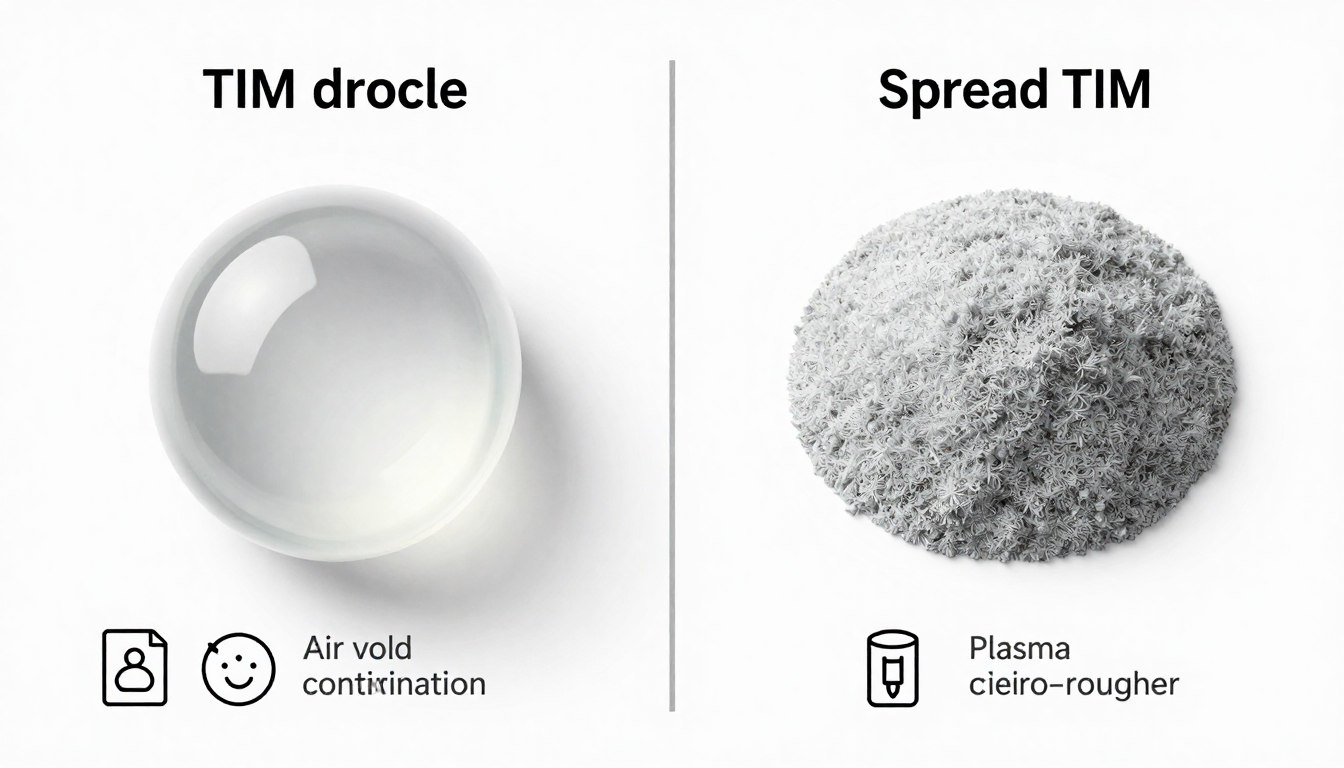
Wetting describes how a liquid (or a TIM in its flow state) spreads over a solid. It’s quantified by the contact angle (θ). For a TIM to perfectly wet a surface and displace air, the surface energy of the substrate (γ_s) must be greater than the surface tension of the TIM (γ_l).
- Good Wetting (Low θ): γ_s > γ_l. The TIM spreads, maximizing contact area.
- Poor Wetting (High θ): γ_s < γ_l. The TIM beads up, trapping air pockets.
Common Surface Energy Challenges & Solutions:
- Low-Energy Surfaces (Plastics, Certain Coatings): Many polymer housings or conformal coatings have low surface energy, causing poor wetting for standard TIMs.
- Solution: Apply a surface treatment like corona, plasma, or flame treatment. These processes introduce polar functional groups, dramatically increasing the surface’s γ_s and enabling adhesion.
- High-Energy but Contaminated Surfaces (Metals): Bare metals (Cu, Al) have high γ_s, but are often covered with low-energy hydrocarbon contamination or weak oxide layers from atmospheric exposure.
- Solution: Implement a cleaning process (UV-Ozone, solvent, or plasma cleaning) immediately before TIM application to reveal the pristine, high-energy metal surface.
- TIM Formulation for Specific Surfaces: The γ_l of the TIM can be engineered. Adding surfactants or coupling agents can lower its surface tension, allowing it to wet more difficult surfaces. However, this can affect bulk properties and long-term stability.
The Process Imperative:
Specifying the right TIM is only half the battle. Controlling the surface state of the substrate at the moment of application is equally critical. A defined surface preparation step (cleaning, treatment) is often the most cost-effective way to slash thermal interface resistance and boost reliability.
We provide surface energy compatibility guidance and can formulate TIMs with tailored wetting characteristics, ensuring your material performs optimally on the specific surfaces in your assembly.