The First-Contact Champion: Why Thermal Effusivity Matters More Than Conductivity in Pulsed Applications
In applications where heat is generated in microsecond bursts, the initial temperature spike is not governed by steady-state thermal conductivity, but by a material’s thermal effusivity (e). While conductivity (k) describes the ability to move heat, effusivity describes the ability to absorb and diffuse heat upon first contact—making it the paramount property for transient thermal management.
The Physics of Effusivity:
Thermal effusivity is defined as: e = √(k * ρ * Cp)
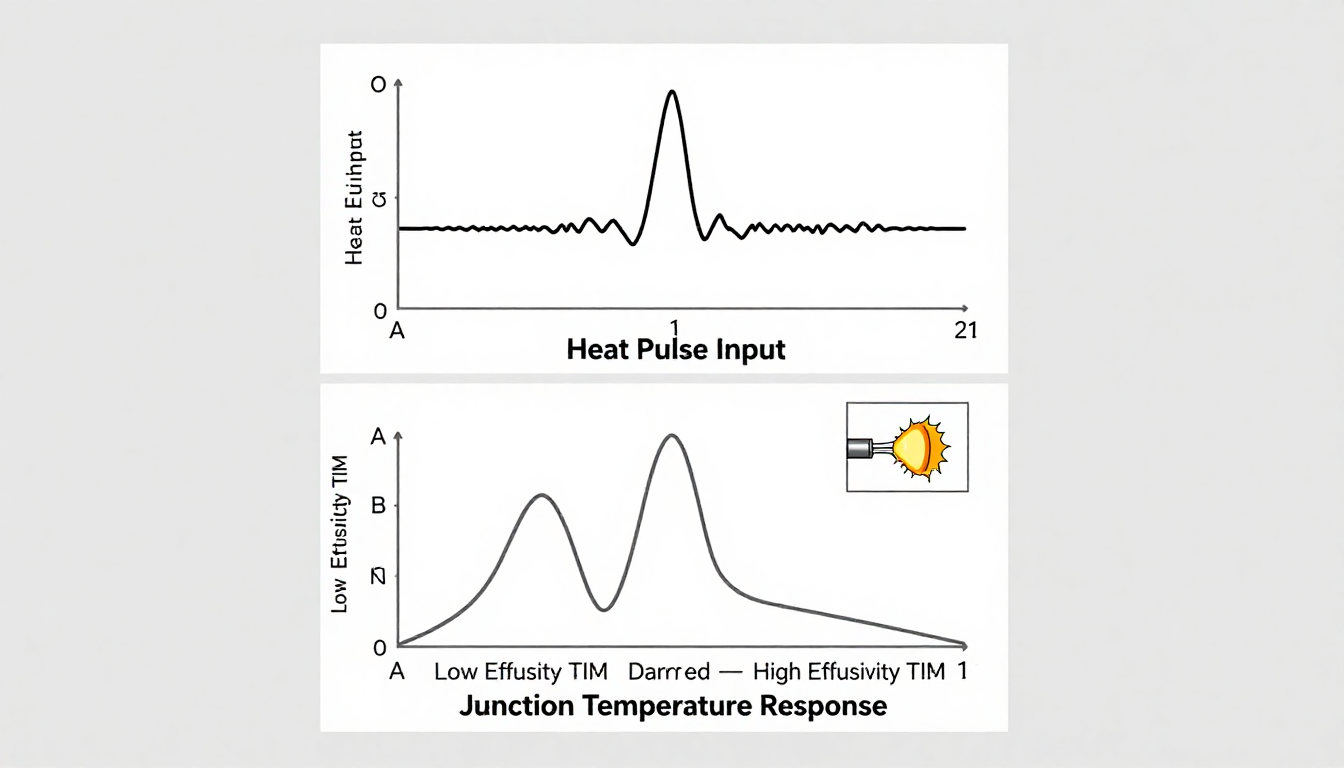
Where *k* is thermal conductivity, ρ is density, and Cp is specific heat capacity. It quantifies the “thermal impedance” a material presents to a sudden heat flux. A high-effusivity TIM acts like a thermal shock absorber, quickly soaking up the initial heat pulse and preventing a sharp temperature rise at the source, before steady-state conduction takes over.
Why Effusivity Wins in Transient Scenarios:
- Mitigating Peak Temperature: For a laser diode pulsed for 100µs, a high-effusivity TIM will result in a significantly lower peak junction temperature than a high-conductivity, low-effusivity one, directly impacting device reliability and performance.
- The Material Trade-Off: A material can have high conductivity (e.g., graphite sheet) but moderate effusivity if it has low density or specific heat. Conversely, a metal-based TIM or a heavily filled composite often has superior effusivity due to high ρ and Cp.
Selecting and Designing for Effusivity:
- Request the Data: Challenge suppliers to provide effusivity values alongside conductivity. This shifts the conversation from a single metric to a more complete transient performance profile.
- The Strategic Layer: In pulsed systems, consider a bilayer TIM approach: a thin, high-effusivity layer directly on the die to blunt the initial spike, backed by a high-conductivity layer (like graphite) to spread the heat laterally.
- Simulation Input: For accurate transient thermal modeling (e.g., in ANSYS Transient Thermal), input the correct effusivity (or k, ρ, Cp separately) to predict true peak temperatures.
For engineers battling nanosecond or microsecond heat bursts, mastering effusivity is the key to unlocking the next level of protection for sensitive components. Our material development prioritizes both high conductivity and high effusivity for the most demanding transient challenges.