The Quantum of Heat: Engineering TIMs for Efficient Phonon Transport Across Material Interfaces
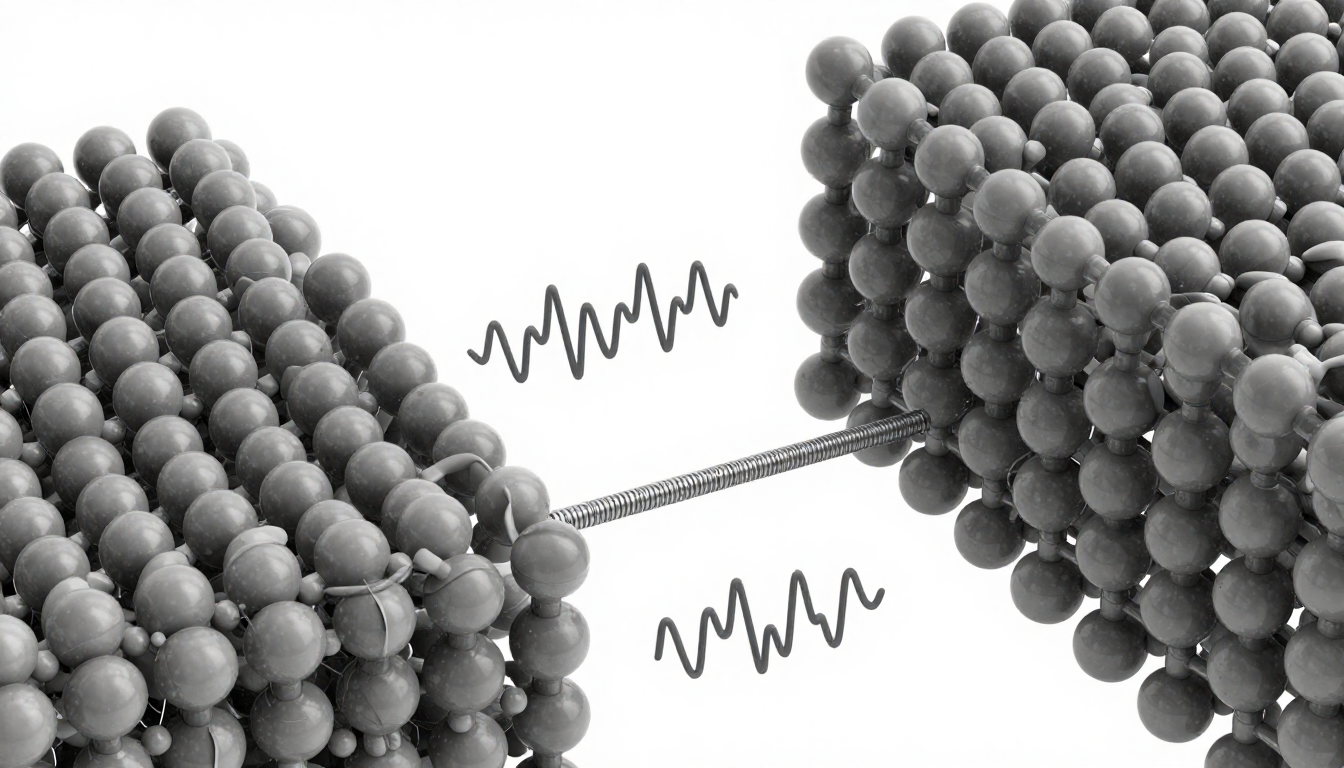
At the nanoscale, heat is not a fluid but a vibration—carried by quantized lattice waves called phonons. The ultimate limit on Thermal Interface Material (TIM) performance is not just bulk conductivity, but the phonon transmission probability across the boundaries between the chip, the TIM, and the heatsink. This quantum phenomenon is described by the thermal boundary conductance (TBC) or its inverse, the Kapitza resistance.
The Fundamental Bottleneck: Phonon Mismatch
When phonons reach an interface between two materials (e.g., Silicon and Polymer), they scatter due to differences in:
- Acoustic Impedance: A mismatch causes phonon reflection, like light bouncing off a different medium.
- Phonon Spectrum Density: Different materials vibrate at different frequencies; high-frequency phonons from silicon may not “fit” into the vibrational modes of the TIM polymer.
Advanced Strategies to Boost Phonon Transport:
- Ultra-Thin Metallic & 2D Material Interfaces: Materials like graphene or ultrathin aluminum films can have exceptionally high TBC with semiconductors because their lattice vibrations better match. They are being researched as “phonon coupling” layers within traditional TIM stacks.
- Molecular Coupling and Self-Assembled Monolayers (SAMs): Chemically grafting organic molecules to the silicon surface that are compatible with the TIM polymer can create a graduated acoustic impedance bridge, enhancing phonon transmission.
- Nanostructured and Aligned Fillers: Aligning high-conductivity, crystalline fillers (BNNTs, diamond) perpendicular to the interface can create direct phonon highways through the TIM, minimizing scattering in the polymer matrix.
Measuring the Unseen:
Techniques like Time-Domain Thermoreflectance (TDTR) are used in research to directly measure the TBC of interfaces, moving beyond bulk properties to understand the true interfacial bottleneck.
While this is frontier science, its principles guide our advanced material development. By engineering filler morphology, interface chemistry, and matrix properties, we work to push TIM performance closer to the fundamental limits imposed by phonon physics.