From First Principles: Using Computational BTE Solvers to Design Next-Generation TIMs from the Atom Up
The traditional trial-and-error method of developing Thermal Interface Materials (TIMs) is slow and costly. The future lies in predictive computational design. By solving the Boltzmann Transport Equation (BTE) for phonons—the fundamental equation governing heat conduction in solids—we can virtually prototype materials, predicting their thermal conductivity from first principles and accelerating the discovery of breakthrough TIMs.
The Computational Workflow:
- Atomistic Inputs (Density Functional Theory – DFT): First, the vibrational properties (phonon dispersion) of a candidate material’s crystal structure are calculated from quantum mechanics. This tells us all the possible phonon modes and their velocities.
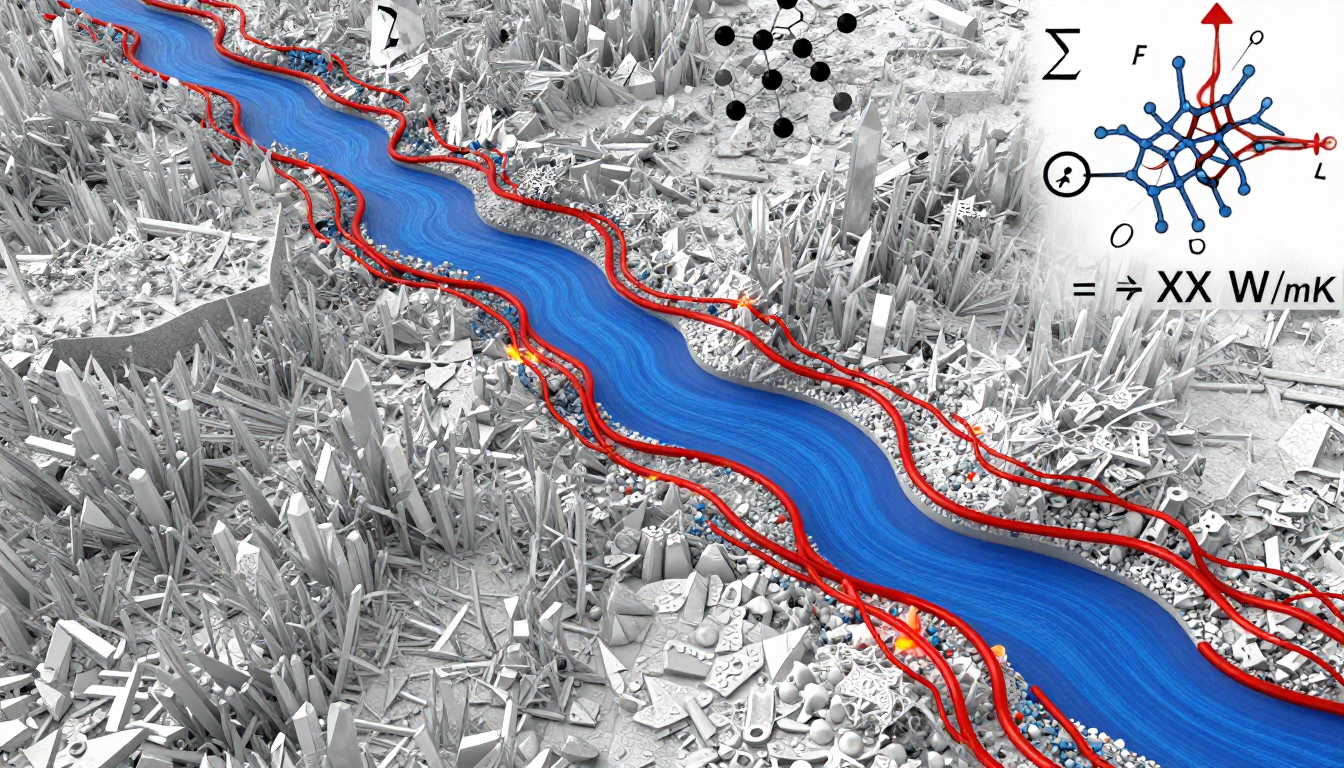
- Solving the BTE: Advanced solvers (like Spectral Monte Carlo or iterative methods) then simulate how these phonons travel and scatter. They account for:
- Intrinsic scattering: Phonon-phonon interactions (Umklapp processes).
- Extrinsic scattering: Defects, grain boundaries, and most critically for TIMs, interfacial scattering between fillers and the matrix.
- Predicting Performance: The output is the intrinsic lattice thermal conductivity of the bulk material and, with more advanced coupling to molecular dynamics, the thermal boundary conductance at interfaces.
Impact on TIM Development:
- Virtual Screening: Thousands of potential filler materials (e.g., exotic ceramics, alloys) or polymer backbones can be screened computationally to identify candidates with inherently high conductivity or ideal phonon spectra.
- Interface Engineering: Simulations can model how surface functionalization (adding specific molecular groups to a filler) alters the phonon coupling at the interface, guiding chemists to design better bonding agents.
- Microstructure Optimization: For composite TIMs, BTE solvers can predict the optimal filler size, shape, and distribution to minimize scattering and maximize percolation.
This approach transforms TIM R&D from a materials-centric to a data- and simulation-centric discipline. While requiring significant computational power and expertise, it drastically reduces the time and cost of bringing advanced materials to market. We employ these computational tools to guide our exploration of next-generation composite systems.