Programming Matter: Using DNA Origami to Assemble Perfect Nanoscale Thermal Pathways
The quest for the perfect Thermal Interface Material (TIM) is a quest for perfect filler dispersion and connection. Today’s composites are stochastic—fillers are randomly mixed. What if we could program their position and connection at the molecular level? DNA origami, the art of folding synthetic DNA into precise 2D and 3D shapes, offers a revolutionary toolkit to do exactly that: act as a programmable scaffold to arrange high-conductivity nanoparticles (like diamonds, BNNTs) into theoretically optimal thermal networks.
The Mechanism: DNA as a Smart Construction Scaffold
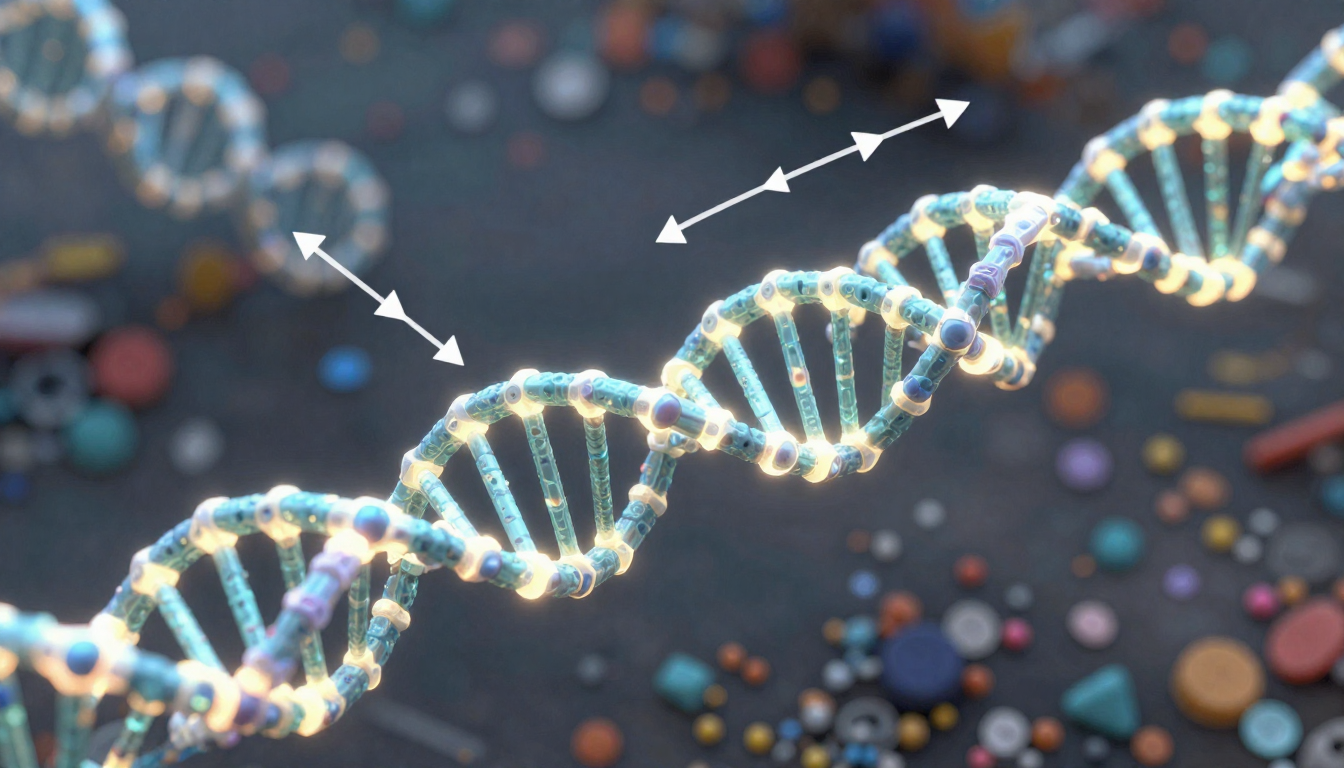
Strands of synthetic DNA can be designed to have specific binding sites (“sticky ends”). By attaching complementary DNA strands to the surface of nanoparticles, we can use pre-folded DNA origami structures as templates or frames.
- Precision Placement: Nanoparticles functionalized with DNA “A” are directed to bind only to matching sites “A'” on the DNA scaffold, placing them at defined intervals and orientations.
- Network Formation: Multiple scaffolds can be designed to link together, creating extended, ordered 3D networks of perfectly spaced and connected fillers—a phonon highway with minimal scattering sites.
- Dynamic Response: DNA bonds can be designed to break and reform under specific triggers (temperature, pH). This could enable a self-assembled network that reconfigures itself to repair gaps caused by damage or stress.
Implications for Ultimate Performance:
This bottom-up approach aims to solve the core inefficiencies of composite TIMs: agglomeration, poor interfacial coupling, and random percolation. Theoretically, it could produce materials approaching the theoretical maximum thermal conductivity for a given filler volume fraction, as every particle is optimally placed and bonded.
The Grand Challenge:
This is foundational, lab-scale science. The hurdles are immense: stability of DNA at high temperatures, cost of scale-up, integration into polymer matrices, and ensuring the DNA itself doesn’t become a thermal insulator. It is a long-term vision for extreme-performance niches like quantum computing or aerospace, where material perfection justifies any cost.
This represents not just a new material, but a new paradigm for manufacturing matter: from stochastic mixing to programmable molecular assembly. It is the ultimate convergence of biotechnology, nanotechnology, and thermal science.