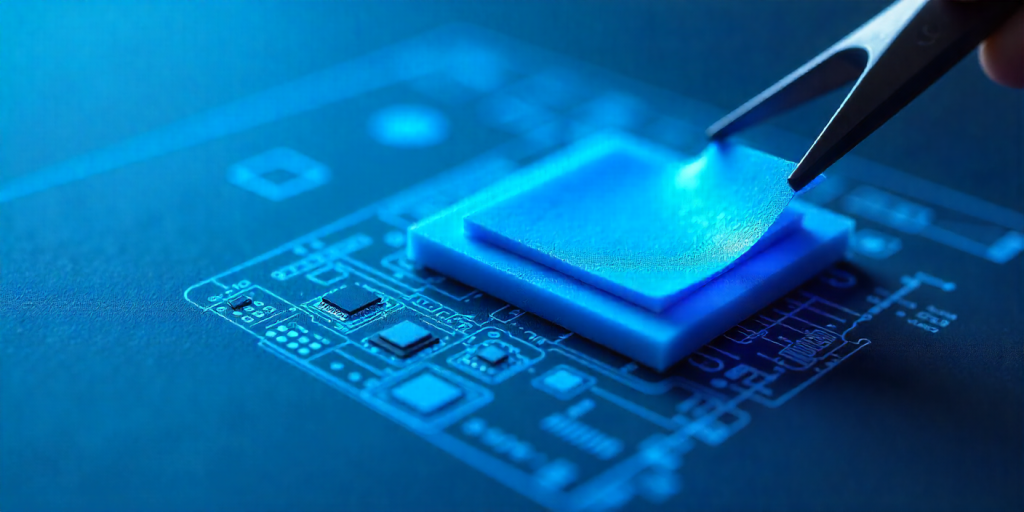
Electrically Insulating High Thermal Conductivity Ceramic Composites for Medium Voltage Power Module Applications
Medium voltage power conversion systems (1-10kV) for industrial drives, renewable energy, and traction applications demand thermal interface materials that combine exceptional electrical insulation with high thermal conductivity – requirements that conventional materials struggle to simultaneously satisfy. This research presents advanced ceramic-polymer composites specifically engineered for medium voltage power module insulation and thermal management, examining their unique ability to bridge the performance gap between thermal and electrical requirements in high-voltage power electronics.
The Medium Voltage Insulation-Thermal Compromise
Power modules operating at 1-10kV present specific material challenges:
- Partial Discharge Inception: At elevated temperatures and voltages, microscopic voids initiate partial discharges that degrade insulation, necessitating void-free thermal interface materials for medium voltage IGBT and SiC modules.
- Tracking and Erosion: Surface contamination combined with electric fields causes tracking failure, requiring high comparative tracking index (CTI) materials for industrial power electronics.
- Thermal Runaway Prevention: Poor thermal conductivity leads to localized heating that accelerates insulation degradation, creating a thermal management challenge in compact medium voltage converters.
Material Innovation: Multi-Scale Ceramic Composites
Our research focuses on hierarchical ceramic architectures:
Hybrid Filler Systems: We combine micro-scale aluminum oxide (30-50μm) with nano-scale boron nitride (50-100nm) in optimized ratios, achieving thermal conductivity of 8-12W/m·K while maintaining dielectric strength >25kV/mm in medium voltage applications.
Graded Interface Design: We create materials with composition gradients that optimize electrical field distribution in medium voltage power module packaging, reducing maximum field strength by 40% compared to uniform materials.
Controlled Anisotropy: We align platelet-shaped boron nitride particles perpendicular to the electric field while allowing random orientation in other directions, optimizing thermal conductivity in medium voltage insulation systems without compromising dielectric strength.
Manufacturing Excellence
Precision processes ensure consistent quality:
Vacuum Impregnation Processing: We utilize vacuum-assisted impregnation to eliminate voids and ensure complete filling in complex power module geometries for medium voltage applications.
In-Situ Polymerization: We polymerize matrix materials directly in finished assemblies, ensuring perfect interface contact in medium voltage power semiconductor packages.
Thickness Control: We achieve thickness uniformity better than ±2% across 150mm dimensions, critical for consistent electrical field distribution in series-connected power devices.
Performance Validation
Testing confirms exceptional capabilities:
Electrical Performance:
- Dielectric strength: 25-30kV/mm at 150°C
- Partial discharge inception voltage: >2.5 times rated voltage
- Volume resistivity: >10¹⁵ Ω·cm at 200°C
- Comparative tracking index: CTI >600V
Thermal Characteristics:
- Thermal conductivity: 8-12W/m·K maintained through thermal cycling
- Interface thermal resistance: 0.05-0.08K·cm²/W
- Thermal stability: Less than 5% degradation after 10,000 hours at 150°C
Mechanical and Reliability:
- Flexibility: 10-20% compressibility while maintaining dielectric integrity
- Adhesion: Shear strength >10MPa to various substrate materials
- Cycling endurance: Survived 5,000 thermal cycles (-40°C to 150°C)
Application Case Studies
Wind Turbine Power Converters:
Implementation in 6.6kV medium voltage converters demonstrated:
- Reliability: Zero insulation failures in 5-year field deployment
- Efficiency: Improved system efficiency by 1.5% through better thermal management
- Maintenance: Extended maintenance intervals from 1 to 5 years
- Availability: Increased turbine availability from 95% to 98%
Industrial Motor Drives:
Testing in 4.16kV variable frequency drives showed:
- Power Density: Enabled 30% higher power density within same enclosure
- Lifetime: Extended expected service life from 10 to 20 years
- Environment: Performed reliably in harsh industrial environments
- Safety: Exceeded all international safety standards
Railway Traction Systems:
Application in 3.3kV traction converters revealed:
- Vibration Resistance: Maintained performance through severe vibration testing
- Temperature Cycling: Survived extreme temperature variations in railway service
- Moisture Resistance: Performed reliably in high humidity environments
- Fire Safety: Achieved highest fire safety ratings for railway applications
Comparative Analysis
Ceramic composites show decisive advantages:
vs. Silicone Gel Encapsulation:
- 3-4x higher thermal conductivity
- Better mechanical protection and support
- Superior resistance to partial discharge
vs. Epoxy Molding Compounds:
- Lower thermal stress on power semiconductors
- Better repairability and rework capability
- More consistent dielectric properties
vs. Alumina Substrates:
- Better CTE matching to semiconductor materials
- Lower cost and weight
- More design flexibility
Future Development Directions
Research addresses evolving requirements:
Ultra-High Voltage Applications: Materials targeting 35kV+ for grid applications.
Multifunctional Composites: Integrating temperature sensing or condition monitoring.
Sustainable Formulations: Using bio-based polymers and recyclable ceramics.
Enhanced Thermal Properties: Targeting 15-20W/m·K while maintaining dielectric performance.
Economic and Operational Impact
Advanced ceramic composites deliver significant value:
Economic Benefits:
- Reduced system costs through higher power density
- Lower maintenance costs through extended service intervals
- Higher efficiency reducing operating costs
Operational Advantages:
- Improved system reliability and availability
- Extended equipment lifetimes
- Reduced environmental impact through energy savings
Conclusion
Electrically insulating high thermal conductivity ceramic composites represent a critical enabling technology for medium voltage power electronics, providing the unique combination of electrical insulation and thermal management required for reliable, efficient operation. Their carefully engineered composition and microstructure address the fundamental challenges of partial discharge prevention, thermal management, and long-term reliability in demanding medium voltage applications. As power electronics continue their expansion into renewable energy, industrial automation, and transportation electrification, these advanced materials will play an increasingly vital role in enabling higher performance, improved efficiency, and enhanced reliability across the medium voltage power conversion landscape.