Hearing the Failure: Using Acoustic Emission to Detect TIM Delamination and Crack Propagation In-Situ
Most TIM failures are detected too late—when temperature spikes or the device fails. Acoustic Emission (AE) monitoring offers a paradigm shift: listening to the material itself as it fails. This non-destructive technique detects high-frequency stress waves generated by internal events like micro-cracking, delamination, and void formation within a TIM or at its interfaces, providing real-time health diagnostics.
How Acoustic Emission Works for TIMs:
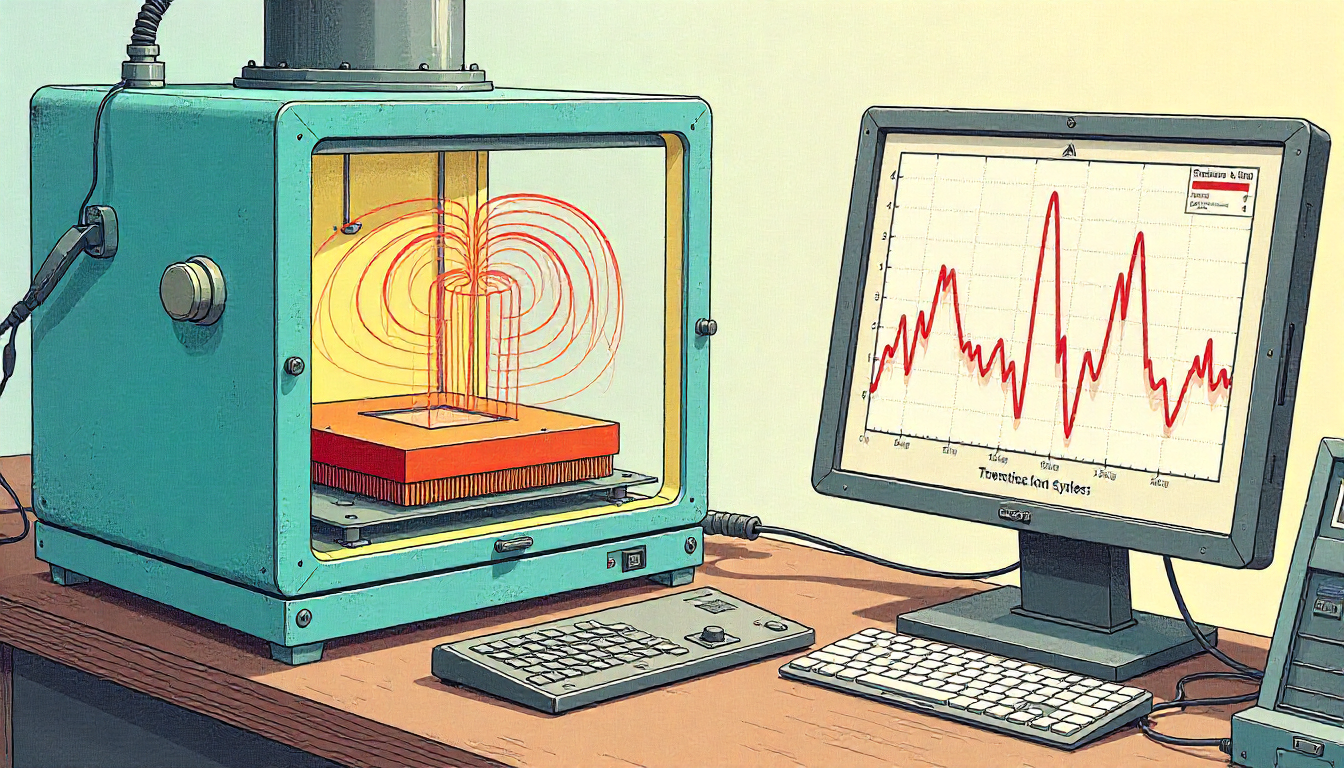
When a TIM is stressed (thermally or mechanically), localized damage events release stored elastic energy as transient ultrasonic waves. Piezoelectric sensors attached to the assembly detect these waves. The amplitude, frequency, and rate of these “acoustic emissions” are correlated with the type and severity of damage.
Application in TIM Reliability:
- Accelerated Life Testing: Instead of waiting for a thermal resistance measurement at the end of a test cycle, AE sensors can pinpoint the exact cycle when the first micro-delamination occurs in a phase change pad or when a solder TIM crack initiates, providing invaluable failure mechanism insights.
- Differentiating Failure Modes: The acoustic signature of adhesive failure (TIM detaching from a surface) often differs from cohesive failure (cracking within the TIM bulk) or the subtle tearing associated with pump-out.
- Prognostic Health Monitoring (PHM): In critical systems (aerospace, server farms), permanently installed AE sensors could theoretically monitor TIM health, providing an early warning for preventative maintenance long before a thermal runaway event.
Implementing AE Analysis:
While traditionally a lab technique, it requires expertise in sensor placement, signal filtering, and pattern recognition. The resulting data, however, provides an unmatched view into the real-time degradation mechanics of your thermal interface.
By partnering with labs that employ AE, you can move beyond pass/fail testing to a deeper understanding of how and when your TIM fails, enabling more predictive reliability models and the development of truly failure-resistant materials.