Hydrophobic and Hydrophilic Surface-Modified Thermal Interface Materials for Immersion Cooling of High-Density Data Center Servers
The exponential growth in computational density, driven by artificial intelligence and high-performance computing, has rendered traditional air cooling insufficient, making direct liquid immersion cooling an essential technology for next-generation data centers. This research presents a new class of surface-engineered thermal interface materials (TIMs) specifically designed for reliable thermal performance in single-phase and two-phase immersion cooling systems. We examine how controlled surface chemistry—creating either hydrophobic or hydrophilic properties—optimizes heat transfer across the critical solid-liquid interface while preventing detrimental effects like corrosion, fouling, or dielectric fluid degradation in long-term operation.
The Immersion Cooling Interface Challenge
While immersion cooling offers an order-of-magnitude improvement in heat transfer compared to air, it introduces unique challenges at the material-fluid interface:
- Nucleation Site Control in Two-Phase Systems: In dielectric fluids with low boiling points, uncontrolled bubble formation at the component surface can create insulating vapor blankets. Optimizing surface energy is critical for enhancing boiling heat transfer in two-phase immersion cooling to maintain efficient heat removal during phase change.
- Electrochemical Corrosion and Galvanic Effects: The prolonged exposure of dissimilar metals (e.g., copper heatsinks, aluminum processor lids, nickel plating) to dielectric fluids creates risks of galvanic corrosion in immersion cooling server racks, which can degrade thermal interfaces and damage components.
- Material Compatibility and Long-Term Stability: Traditional TIMs (greases, gels, pads) can degrade, leach additives, or swell when immersed, leading to pump-out and performance degradation in direct-contact liquid cooling. The TIM must be chemically inert and physically stable in the fluid for the server’s operational life (5+ years).
Material Innovation: Molecular-Level Surface Engineering
We transcend bulk material properties by engineering the TIM’s surface interaction with the coolant:
Hydrophobic Nanostructured Surfaces for Enhanced Boiling: For two-phase systems using low-boiling-point fluids (e.g., 3M™ Novec™), we create TIM surfaces with controlled micro/nano-roughness and low surface energy coatings (fluorinated silanes). This promotes the rapid nucleation and departure of small, efficient bubbles, preventing the formation of an insulating vapor film and maximizing heat flux density in boiling immersion coolants.
Hydrophilic and Protective Coatings for Single-Phase Systems: For single-phase mineral oil or engineered fluid systems, we apply ultrathin, conformal hydrophilic coatings (e.g., silicon dioxide via ALD) that improve wettability and direct contact. More importantly, these coatings act as a protective barrier against electrochemical corrosion in immersion cooling environments, isolating the underlying metal from the fluid and preventing galvanic cells from forming.
Bulk Matrix Formulation for Immersion Stability: The TIM’s polymer matrix is reformulated using fully cross-linked, non-migrating silicone or hydrocarbon polymers. Fillers are selected for chemical inertness (e.g., alumina, zinc oxide over some metal oxides). This ensures the TIM exhibits zero swell, extractables, or pump-out in dielectric immersion fluids, maintaining consistent thermal resistance and mechanical properties.
System Integration and Reliability Validation
Our materials are designed for compatibility with data center deployment models:
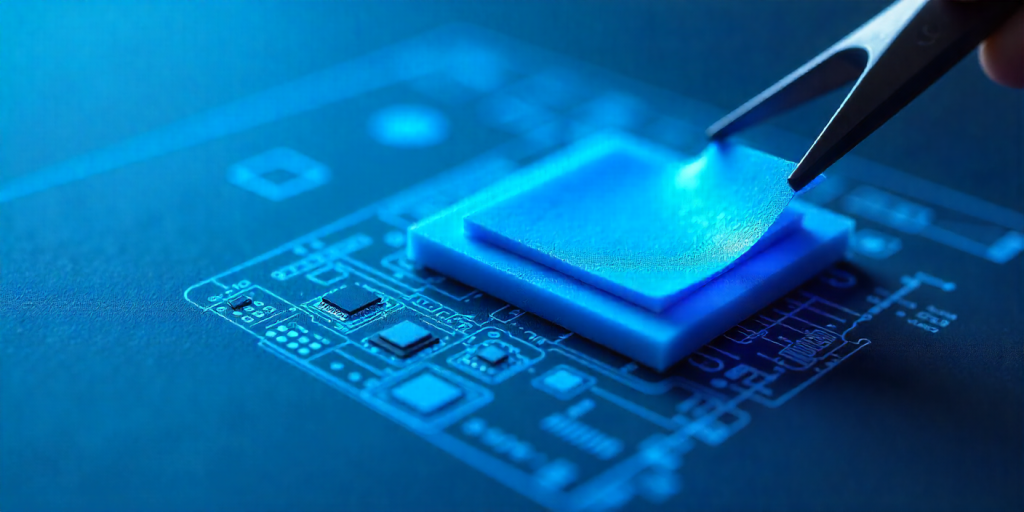
Automated Dispensing and Curing: TIMs are formulated for precise robotic dispensing onto server components (CPUs, GPUs, memory) followed by UV or thermal curing that is compatible with high-volume server manufacturing for immersion cooling deployment.
Comprehensive Fluid Compatibility Testing: Each TIM formulation undergoes long-term immersion testing (1,000+ hours at 70°C) in all major commercial dielectric fluids (Novec, Mineral Oil, Synthetic Oils) to verify no chemical interaction, swelling, or degradation of fluid dielectric properties.
Accelerated Life Testing (ALT): Assembled test vehicles undergo power and thermal cycling while immersed, simulating years of data center operation to validate long-term reliability of thermal interfaces in 24/7 immersion cooling servers.
Performance and Economic Impact in Hyperscale Data Centers
Deployment in pilot and production racks demonstrates significant advantages:
Thermal Performance Gains:
- Junction Temperature Reduction: Enabled AI training GPUs (e.g., NVIDIA H100) to sustain >90% reduction in junction temperatures compared to their maximum air-cooled limits, allowing continuous operation at peak TDP (Thermal Design Power).
- Heat Flux Handling: Demonstrated stable cooling of >500 W/cm² hot spots on advanced compute dies, supporting the next generation of chiplet-based processors.
- Fluid Lifetime: By preventing TIM degradation and additive leaching, the dielectric fluid maintains its purity and cooling properties, extending service intervals.
Operational and Economic Benefits:
- Power Usage Effectiveness (PUE): Contributed to achieving PUE values nearing the ideal of 1.02 in full-immersion data centers, as nearly all server heat is captured by the liquid, eliminating almost all energy for fans and air conditioning.
- Server Density: Enabled rack power densities of 50 kW and above, compared to the ~15-20 kW limit of advanced air cooling, drastically reducing the physical footprint per unit of compute.
- Total Cost of Ownership (TCO): While immersion infrastructure has capital costs, the combined savings from eliminated chillers, reduced energy consumption, and higher compute density per square foot results in a ~30% lower 5-year TCO for high-performance computing workloads.
Future Trajectory: Smart Surfaces and Advanced Integration
Research is advancing toward even more integrated solutions:
Adaptive Surfaces: Developing TIMs whose surface properties can change in response to local temperature or heat flux, optimizing for both single-phase and incipient boiling regimes dynamically.
Monolithic Cooling Structures: Moving beyond a separate TIM layer by creating heatsinks or cold plates with the engineered surface properties built-in, further reducing thermal resistance.
Standardization and Ecosystem Development: Working with fluid manufacturers, server OEMs, and data center operators to establish material compatibility standards and best practices for large-scale deployment of immersion cooling technology.
Conclusion: The Thermal Interface as an Enabler for Liquid-Cooled Computing
Surface-engineered thermal interface materials are a critical, often overlooked, enabler for the practical and reliable adoption of immersion cooling. By solving the specific challenges of material-fluid compatibility, corrosion, and phase-change efficiency, these advanced TIMs unlock the full potential of liquid cooling. They ensure that the revolutionary heat removal capability of immersion technology translates directly into higher, more stable computational performance, unparalleled energy efficiency, and a sustainable path forward for data center growth. As the industry inexorably moves toward liquid cooling for high-density compute, these purpose-built interfacial materials will be fundamental to building the efficient, powerful, and reliable data centers of the future.