Printing the Interface: Integrating Thermal Management Directly into 3D Printed Metal Components
Additive Manufacturing (AM), or 3D printing, breaks free from the constraints of milling and molding. For thermal management, this allows us to re-imagine the Thermal Interface Material (TIM) not as a separate component, but as a designed region or integrated feature of the cooling structure itself. This convergence of geometry and material science opens new paradigms for cooling high-density electronics.
Strategies for Integrating “The Interface” in AM:
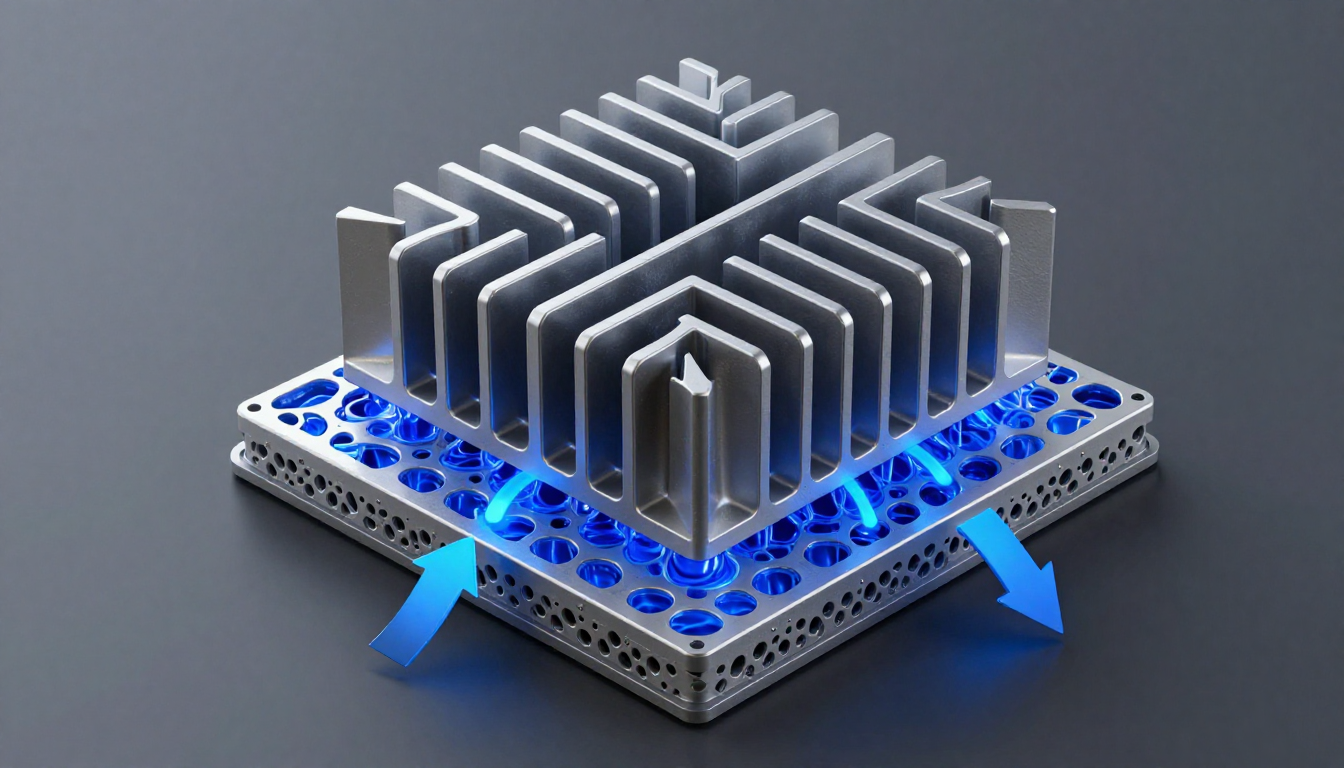
- Engineered Surface Textures: Instead of a flat plate, the mating surface of a 3D printed heatsink can be designed with a micro-scale lattice, pin-fin array, or porous structure. This dramatically increases the surface area for heat transfer. A thermal grease or gel can then be applied to fill this textured volume, creating a mechanical interlock and a huge effective contact area, potentially lowering interface resistance.
- Conformal Cooling Channels with Integrated Thermal Contact: AM excels at printing complex internal channels for liquid cooling. The design can ensure the channel wall is only 0.5-1mm away from the component mounting surface. This minimizes the thermal path, reducing the importance of a traditional TIM. A thin layer of high-performance material is still used, but the conductive distance is radically shortened.
- Graded and Multi-Material Printing (Future Frontier): Emerging multi-material metal AM could, in theory, print a structure with a soft, compliant, conductive alloy at the interface that transitions to a rigid, high-strength alloy for the fins. This would be the ultimate integrated TIM.
- Hybrid Process Integration: Robotic systems could dispense a TIM paste or place a pre-form precisely onto a specific location of a hot, freshly printed part, using the residual heat to cure or bond the material in a single automated cell.
Considerations and Challenges:
- Surface Roughness: As-printed metal surfaces (especially from powder bed fusion) are rough. This can be beneficial for TIM interlocking but may require a compliant TIM to fill the valleys.
- Support Removal and Cleaning: Ensuring the intricate interface surface is free of support material residue is critical.
- Design Complexity: This requires advanced simulation tools to model fluid flow, heat transfer, and stress in these complex organic shapes.
AM transforms the TIM from a purchased sheet into a designed performance zone. It allows for cooling solutions that are truly co-optimized with the electronics they serve, pushing the boundaries of weight, space, and thermal performance.