
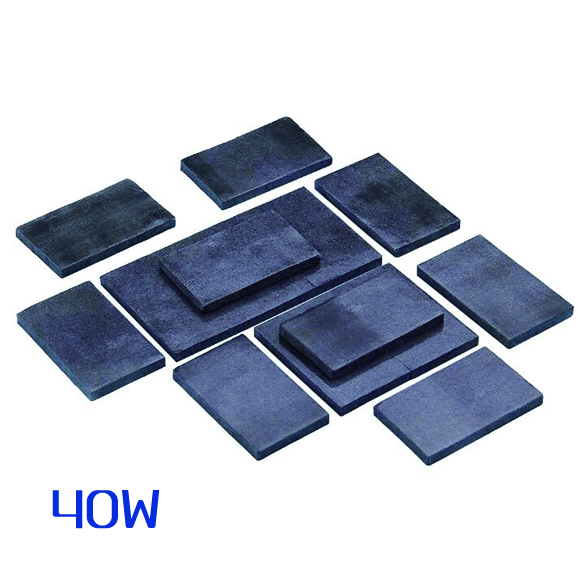
1. Introduction to Carbon Fiber Thermal Pads
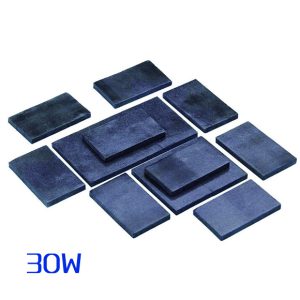
Carbon Fiber Thermal Pads are revolutionary anisotropic composite materials engineered specifically to address hotspot cooling challenges in high-power-density electronics. By utilizing highly aligned internal carbon fibers, they achieve exceptional in-plane heat spreading capacity—far surpassing traditional materials—to rapidly dissipate and evenly distribute heat from concentrated sources like chips. Simultaneously, these pads offer an outstanding strength-to-weight ratio, inherent structural robustness, and built-in electromagnetic shielding (EMI) performance. They represent the ideal solution for cutting-edge applications in 5G communications, aerospace, high-performance computing, and other fields where thermal management, lightweight design, reliability, and electromagnetic compatibility are critically required.
2. Product Specifications Table
| Property | Specification / Description | Notes |
|---|---|---|
| Model | CSF40 | – |
| Thermal Conductivity – In-Plane | 40 W/(m·K) (Typical) | Core metric for lateral heat spreading capability. |
| Thermal Conductivity – Through-Plane | 1.2 – 1.5 W/(m·K) | Demonstrates anisotropic properties. |
| Matrix Material | High-Performance Polymer Matrix | Provides mechanical integrity. |
| Reinforcement | High-Modulus Continuous Carbon Fiber | Provides high strength and primary thermal pathways. |
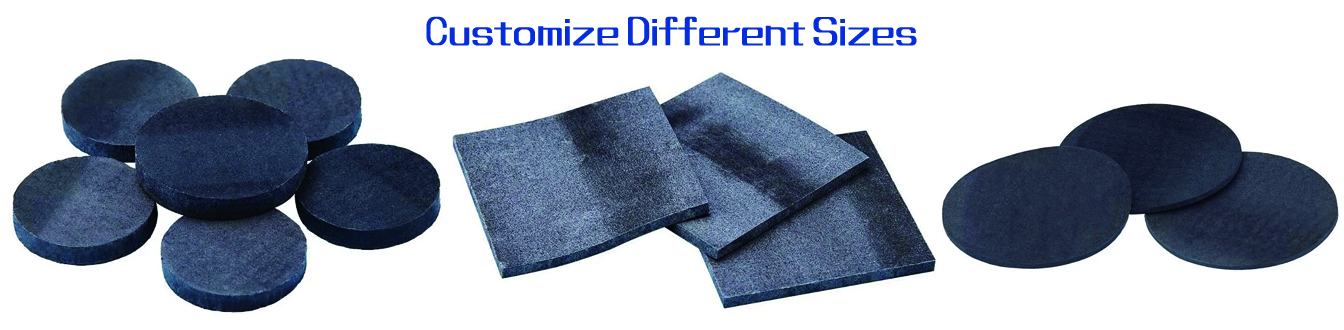
| Thickness | 0.3 ~ 12.0mm (Customizable) | – |
| Density | < 2.6±0.2g/cm³ | Extremely lightweight. |
| Volume Resistivity | < 0.01 Ω·cm | Electrically conductive, provides EMI shielding. |
| Continuous Operating Temperature | -50°C to +160°C | – |
| Flame Rating | UL 94 V-0 | – |
3. Key Features of Carbon Fiber Thermal Pads
-
Exceptional In-Plane Heat Spreading: Its core value lies in its extremely high in-plane thermal conductivity, acting like a “thermal highway” to quickly channel heat from the source to heatsink edges or larger areas, effectively eliminating hot spots.
-
Ultimate Lightweight & High Strength: Carbon fiber provides an excellent strength-to-weight ratio. It adds minimal weight while offering structural support, making it ideal for aerospace and portable devices.
-
Inherent EMI Shielding: The conductive carbon fiber network provides effective electromagnetic interference shielding, solving both thermal and EMI challenges in one material.
-
Superior Dimensional Stability: Extremely low coefficient of thermal expansion (CTE) ensures shape and size stability under severe thermal cycling, guaranteeing long-term, reliable contact.
-
Engineered Anisotropy: Heat is intelligently directed laterally where it’s needed most, optimizing the efficiency of the thermal architecture.

4. Application Fields
-
5G/6G Communication Infrastructure: Heat spreading for GaN power amplifiers in Massive MIMO AAUs, thermal management on antenna radome interiors.
-
Aerospace & Defense Electronics: Lightweight thermal management for radar TR modules, satellite payloads, and airborne high-power computing units.
-
High-Power-Density Power Modules: Heat diffusion for critical power devices in server power supplies, onboard chargers (OBC), and inverters.
-
High-End Consumer Electronics: System-on-chip (SoC) heat distribution in ultra-thin laptops and AR/VR devices.
-
High-Brightness LED Lighting: Substrate for COB LED modules to achieve uniform cooling, enhancing luminous efficacy and lifespan.

-
5. Comparison: Carbon Fiber Thermal Pad vs. Common Thermal Silicone Pads
Comparison Aspect CSF40 Carbon Fiber Thermal Pad Common Thermal Silicone Pad Primary Function Heat Spreader, Thermal Equalizer Heat Conductor, Gap Filler Thermal Characteristic Highly Anisotropic (In-plane >> Through-plane) Isotropic (Similar in all directions) Thermal Conductivity Range In-plane: Very High (10 to >1000 W/m·K); Through-plane: Moderate Bulk: Low to Medium (1.0 – 12.0 W/m·K) Electrical Property Electrically Conductive (Provides EMI Shielding) Electrically Insulating (Requires separate EMI solutions) Mechanical Property High Strength, High Stiffness, Ultra-Thin & Light, Dimensionally Stable Soft, Compressible, Elastic, Provides Some Vibration Damping Key Advantages Solves point-source heating, lightweight, combines cooling & shielding, structural support. Excellent interfacial filling, electrical isolation, easy installation, cost-effective, damping. Typical Applications Cutting-edge comms, aerospace, high-power-density modules. Consumer electronics, automotive electronics, industrial controls, LED lighting (broad). Key Considerations Electrical isolation design is mandatory to prevent short circuits; Higher cost. Potential for drying, cracking, or pump-out under long-term high temperature.
Conclusion: The Carbon Fiber Thermal Pad is not a replacement for traditional thermal silicone pads but an engineering-grade solution born to tackle advanced challenges like extreme heat flux, stringent weight limits, and complex EMI environments. It redefines the possibilities of thermal management and is a critical material for next-generation high-performance electronics.

Reviews
There are no reviews yet.