The Embedded Heat Pipe: Integrating Microfluidic Evaporative Cooling Channels Directly Within the TIM Structure
When heat fluxes push beyond the limits of conduction—even with diamond composites—the most effective solution is phase change: boiling a liquid. Why not make this phenomenon the core of the TIM itself? The concept of a Microfluidic Evaporative Cooling TIM involves etching or embedding a network of microscopic channels and a wick structure directly into the interface layer, creating an integrated, ultra-compact heat pipe that sits directly on the die.
Architecture of an Active TIM:
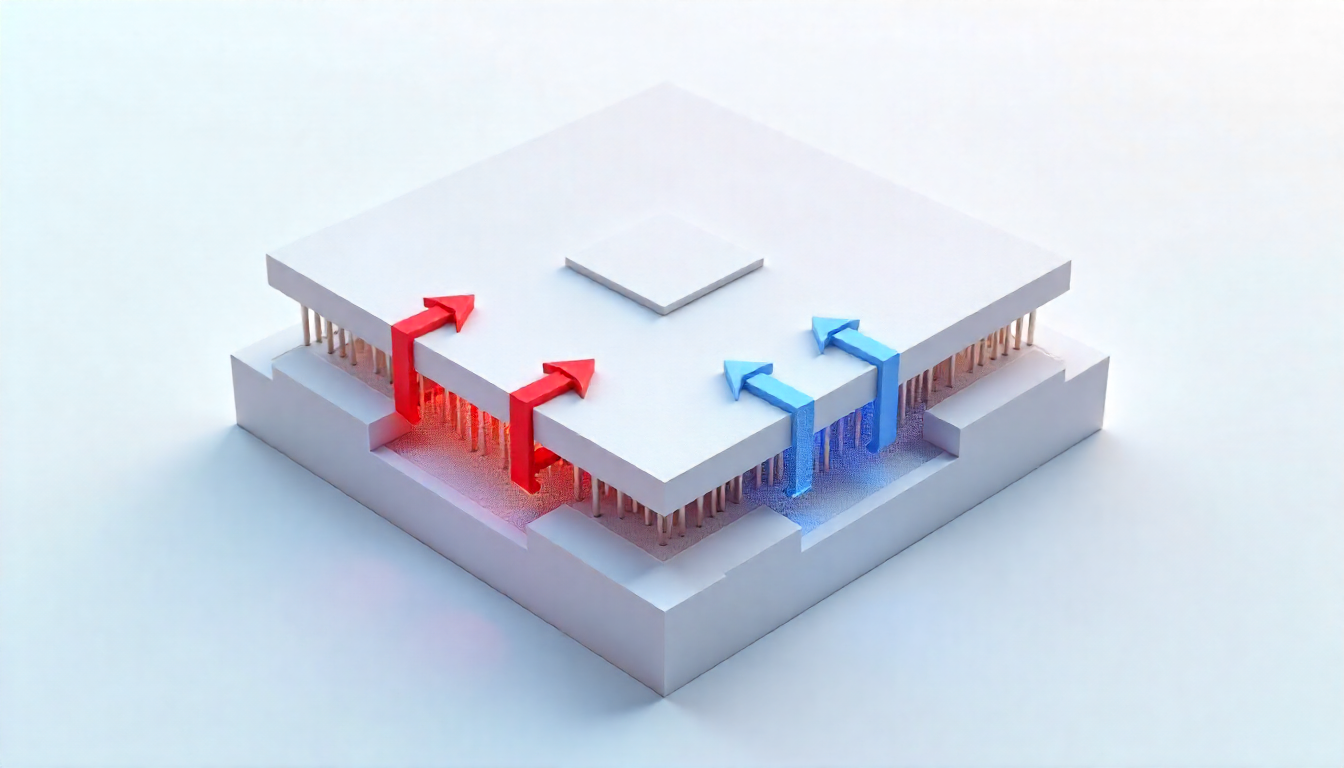
- The Evaporator Region: A porous metal or silicon layer (the TIM’s base) is in direct contact with the hot chip. It is saturated with a dielectric working fluid (e.g., Novec, ethanol).
- Microchannel Vapor Transport: The heat boils the fluid, and the vapor travels through an array of microchannels engineered within the TIM structure.
- The Condenser & Return: The vapor channels lead to a cooled region (the traditional heatsink side), where it condenses. A capillary wick structure, also integrated, pumps the liquid back to the evaporator region via capillary action.
System-Level Advantages:
- Unmatched Heat Flux: Latent heat of vaporization allows for heat removal densities exceeding 500-1000 W/cm², far beyond any solid TIM.
- Isothermal Operation: The boiling process maintains a nearly constant temperature across the die (the fluid’s boiling point), eliminating hotspots.
- Material Efficiency: Replaces bulk conductive materials (copper, alumina) with a thin, active two-phase system.
The Integration Hurdle:
This is a radical departure. It requires co-designing the chip package, TIM, and cooling system as one unit. Challenges include reliable fluid containment over product lifetime, managing start-up and gravitational orientation, and cost.
For the world’s most powerful exascale computing and directed-energy systems, this represents a potential paradigm shift: the convergence of the TIM and the primary cooling loop into a single, hyper-efficient layer. It is the logical end-point for thermal interface technology facing the power densities of the future.