The Invisible Contaminant: How TIM Outgassing Volatiles Plague Vacuum and Optical Systems
In sealed, sensitive, or vacuum environments, the greatest threat from a Thermal Interface Material (TIM) isn’t its thermal resistance—it’s the volatile compounds it slowly releases. This outgassing can condense on cold optical surfaces, foul sensitive instruments, and degrade the vacuum integrity of critical systems, leading to performance loss and costly downtime.
The Science and Standards of Outgassing:
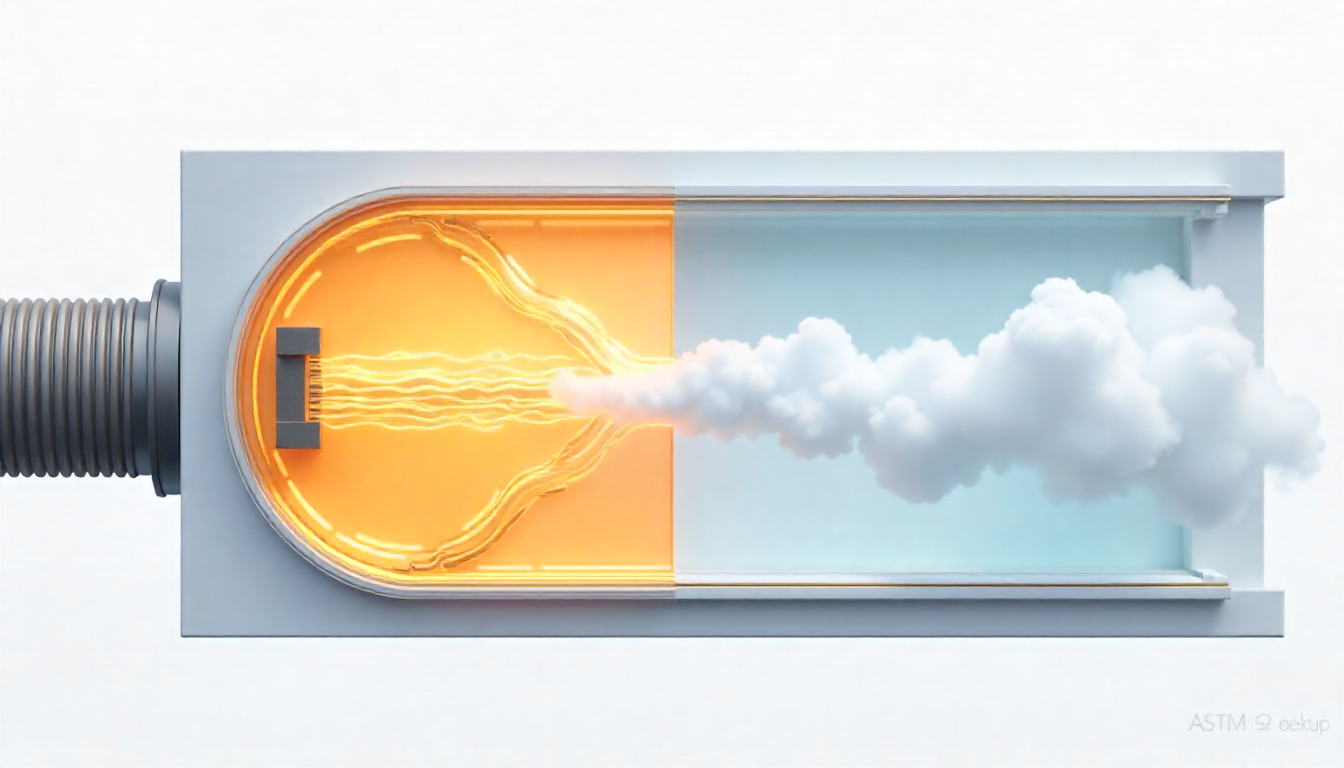
Outgassing occurs as low-molecular-weight components (unreacted monomers, plasticizers, solvents) escape from the polymer matrix over time, especially under heat and vacuum. The industry standard test is ASTM E595, which measures:
- Total Mass Loss (TML): The percentage of mass lost. Typically, a TML < 1.0% is required for space applications.
- Collected Volatile Condensable Materials (CVCM): The percentage of lost mass that re-condenses on a collector plate at 25°C. This is the critical metric for optics and cold surfaces, with requirements often being CVCM < 0.10%.
Failure Modes in Critical Systems:
- Optics Fouling: Condensed volatiles form a tenacious film on lenses, mirrors, and laser windows, scattering light, reducing transmission, and altering calibration. In lidar or satellite imaging systems, this can render the sensor useless.
- Vacuum Degradation: In a high-vacuum chamber (e.g., for semiconductor etching or physics research), outgassing increases the partial pressure of contaminants, interfering with processes and requiring more frequent and costly pump-down cycles.
- Electrical and Sensor Contamination: Condensed organics on electrical contacts can increase resistance; on sensor surfaces, they can create noise or false readings.
Specifying for Purity:
For these applications, standard commercial TIMs are unacceptable. You must explicitly specify “low outgassing” or “vacuum-grade” materials and demand certified ASTM E595 test reports. Materials are often based on specially purified silicones or alternative polymers like polyimides, processed to minimize volatile content.
Choosing the wrong TIM here doesn’t just risk overheating—it can ruin a multi-million dollar instrument. We supply characterized, low-outgassing TIMs with full certification data, ensuring your thermal solution protects the pristine environment of your most sensitive systems.