The Nanoscale Heat Pipe: The Potential of Aligned Carbon Nanotube Arrays as Thermal Interfaces
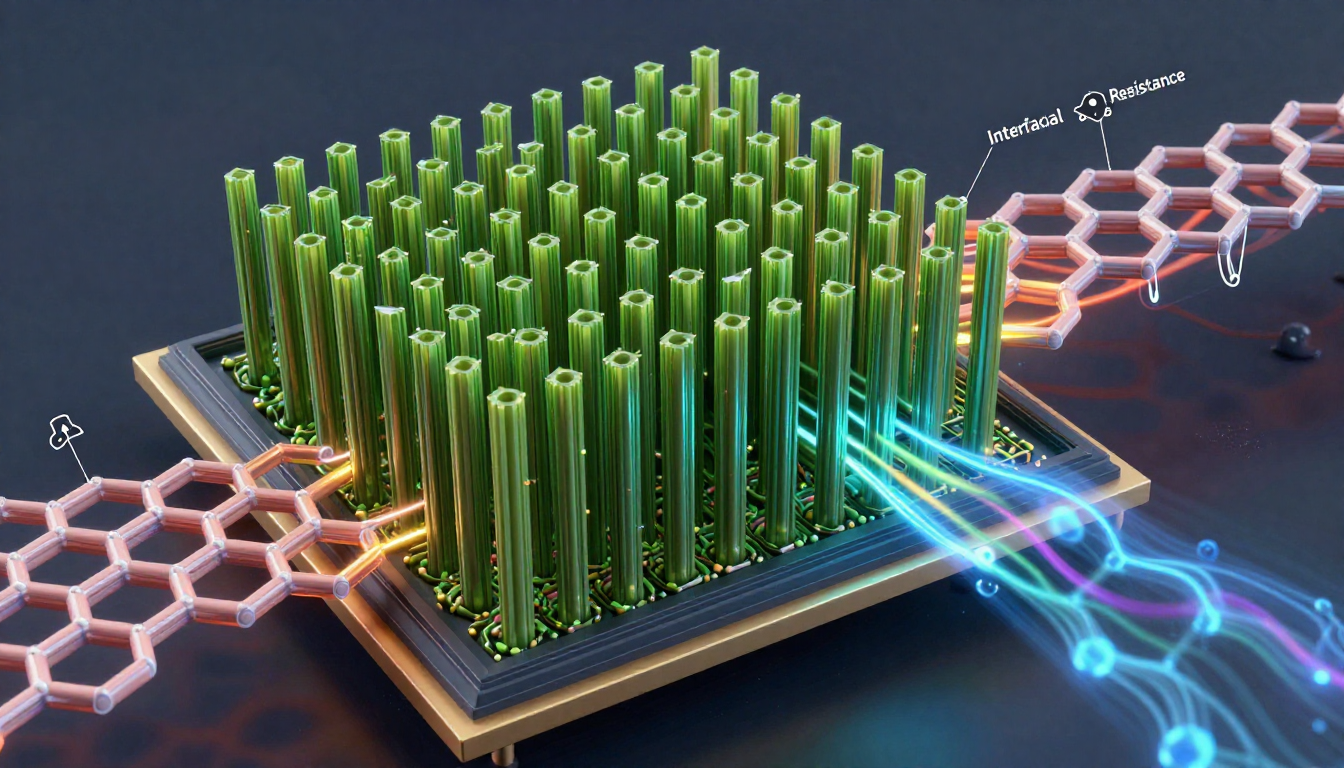
Imagine a Thermal Interface Material (TIM) that is a forest of millions of microscopic, vertically aligned tubes, each an individual champion of heat conduction. This is the vision of Vertically Aligned Carbon Nanotube (VACNT) arrays. With theoretical thermal conductivity rivaling diamond along the tube axis and a structure that is both highly conductive and mechanically compliant, VACNTs represent a tantalizing, albeit challenging, future for thermal interfaces in extreme applications.
The Unique Advantages of VACNT Forests:
- Exceptional Axial Conductivity: Individual single-wall carbon nanotubes (SWCNTs) can have thermal conductivities over 3000 W/m·K. An aligned array leverages this along the Z-axis (through-plane direction), which is exactly what a TIM needs.
- Intrinsic Compliance: The forest is a collection of high-aspect-ratio fibers that can bend and buckle. This allows the array to conform to surface roughness under relatively low pressure, ensuring excellent contact without high stress, much like a brush.
- High Temperature Stability: CNTs are stable in inert atmospheres up to very high temperatures (>700°C).
The Significant Challenges:
- Interfacial Resistance is King: The thermal boundary resistance (TBR) at the ends of each nanotube—where it contacts the chip and the heatsink—is enormous and often dominates the total resistance. Functionalizing the CNT ends with metal (e.g., soldering) is actively researched to solve this.
- Scalable, Uniform Growth: Growing dense, uniform, long VACNT forests on large areas (like entire wafers) with consistent properties is a major materials engineering challenge.
- Integration and Handling: The forests are fragile and can be difficult to transfer and integrate into standard packaging processes. They may require protective capping layers.
Current State and Path Forward:
VACNT TIMs are a promising lab-scale technology being explored by universities and advanced corporate R&D labs, particularly for high-power density, small-area applications like laser diodes or RF amplifiers. The path to commercialization requires breakthroughs in reducing interfacial resistance and developing robust integration schemes.
While not a product today, VACNT research pushes the boundaries of what’s physically possible, guiding our understanding of the ultimate limits of thermal interface performance.