The Slow Sink: Modeling TIM Thickness Loss and Pressure Decay Due to Compressive Creep Over Time
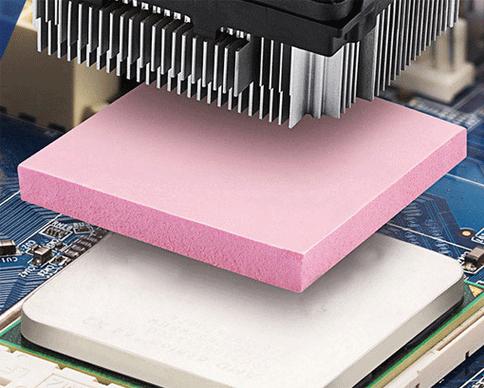
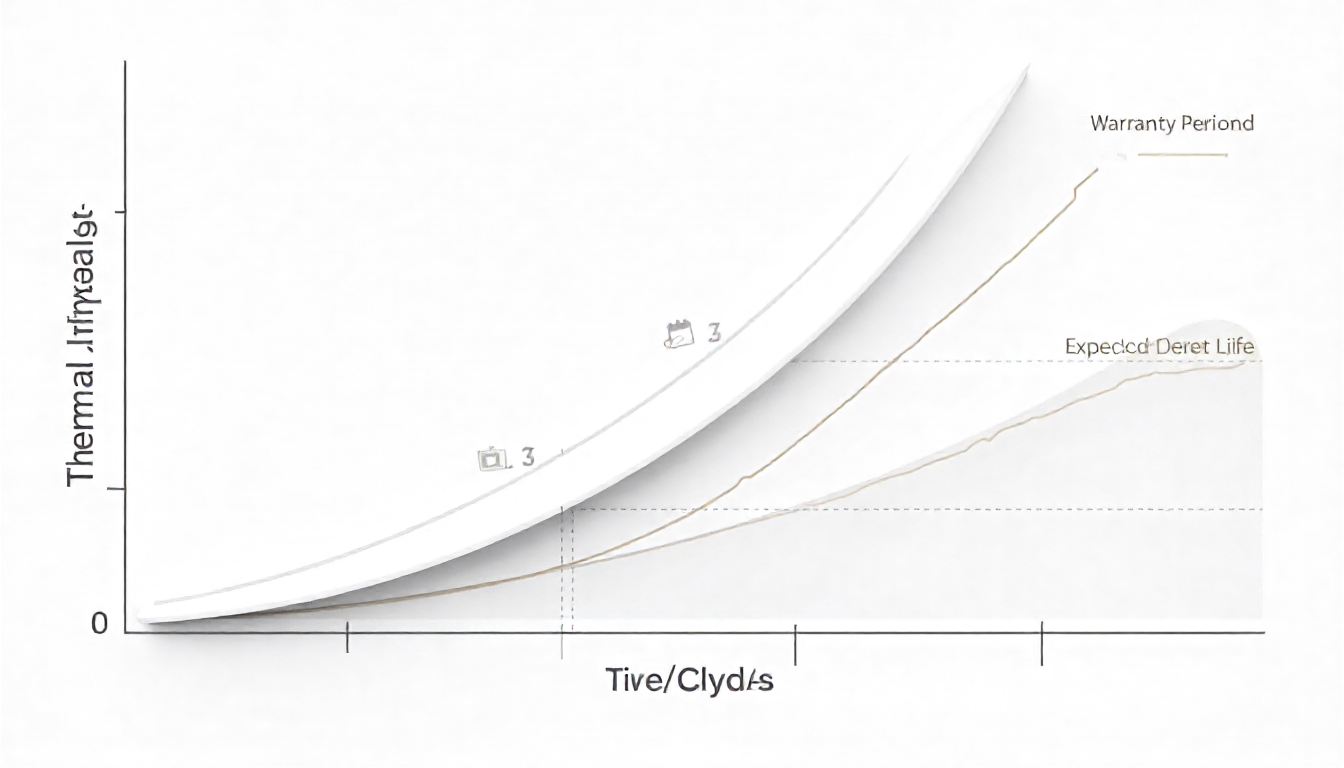
When a Thermal Interface Material (TIM) is placed under constant compressive load—as it is in every heatsink assembly—it doesn’t just compress elastically; it undergoes viscoelastic creep: a slow, continuous deformation over time. This gradual “sinking” leads to a loss of thickness and, critically, a decay of the interface contact pressure, which can cause thermal resistance to rise exponentially over the product’s life.
The Mechanics of Creep and Its Consequences:
- The Three Creep Stages:
- Primary: Rapid initial deformation as the material’s internal structure adjusts.
- Secondary: A steady, slow creep rate—this is the critical region for long-term modeling.
- Tertiary: Accelerated deformation leading to rupture (failure).
- The Thermal Impact: Contact thermal resistance is highly non-linear with pressure. A small drop in pressure (from creep) can cause a disproportionately large increase in thermal resistance, as microscopic contacts separate and air gaps reform.
Quantifying Creep for Design:
Engineers must select TIMs based on creep strain data (often per ASTM D2990) or compressive stress relaxation curves. Key questions for your supplier:
- What is the % thickness loss after 1000 hours under X psi at Y°C?
- What is the residual stress after the same conditioning? (This tells you the remaining clamping force).
Design Strategies to Mitigate Creep:
- Material Selection: Highly filled, cross-linked polymers generally exhibit lower creep than soft, unfilled gels. Phase change materials, after initial flow and resolidification, can have excellent creep resistance.
- Mechanical Design: Use spring-loaded or stiff screw mechanisms that can maintain a near-constant force even as the TIM creeps and thins, rather than relying on displacement-limited stops.
- Pre-Conditioning (Pre-Creep): In some high-reliability applications, assemblies are thermally cycled or “burned-in” to drive the TIM through its primary creep stage before final testing and shipment, ensuring a stable secondary creep phase in the field.
Ignoring compressive creep is designing for time-zero performance only. For mission-critical systems, modeling long-term thickness and pressure loss is essential for true lifecycle thermal management.