The Sound of Silence: Engineering Phononic Crystals into TIMs to Create Directional Heat Guides and Bandgap Insulators
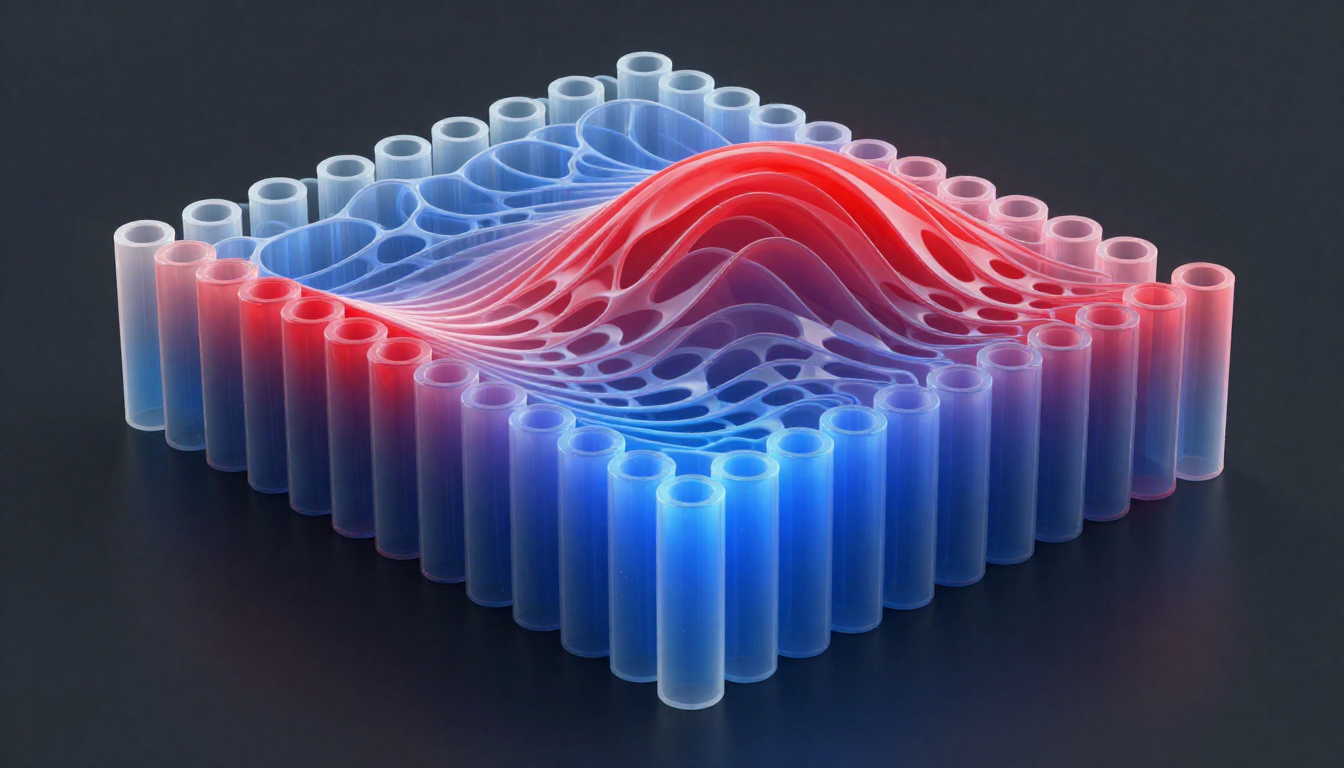
Imagine a Thermal Interface Material (TIM) that can act as a thermal insulator for certain heat “frequencies” while remaining conductive for others, or one that guides heat in specific directions like an optical fiber guides light. This is the promise of phononic crystals—materials with a periodic variation in density and elastic properties that manipulate phonons, the primary heat carriers in dielectrics.
The Core Principle: Phononic Bandgaps
Just as photonic crystals control light, phononic crystals create bandgaps—ranges of phonon frequencies (and thus, thermal energies) that cannot propagate through the material. By embedding a periodic array of inclusions (e.g., air holes, tungsten spheres) within a TIM matrix, we can engineer it to reflect specific, problematic high-frequency phonons back into the hot chip, potentially creating a novel form of thermal isolation at the interface itself.
Potential Applications in Advanced Packaging:
- Frequency-Selective Thermal Management: A phononic TIM could be designed to block the high-frequency phonons emitted by a hot transistor channel, while allowing lower-frequency, less energetic phonons from other regions to pass, effectively creating a thermal filter.
- Anisotropic Heat Routing: By designing an asymmetric lattice, thermal conductivity can be made highly directional. Heat could be guided laterally across the interface to a dedicated sink, preventing it from reaching a sensitive adjacent component.
- Thermal Cloaking & Lens Design: Complex phononic crystal structures could, in theory, bend heat flow around an object or focus it onto a small area, enabling radical new heat sink and spreader designs.
From Theory to Practical TIM:
The challenge lies in fabricating these precise, often microscopic, periodic structures at scale and integrating them into a robust interface. Additive manufacturing (3D printing) at micron scales and self-assembly techniques are key pathways. Initial applications will be in high-value, high-performance computing and RF modules where thermal crosstalk is a critical issue.
This represents the ultimate application of wave physics to heat management. By moving beyond bulk composite properties to engineered dispersion relations, phononic crystal TIMs could redefine how we think about isolating and directing heat at its source.