Thermal Grease vs. Pad: Real-World Performance Benchmarks and When to Use Each
The debate between thermal grease and thermal pads is perennial. Grease promises low initial resistance; pads promise clean application and stability. But which performs better in real-world conditions over time? We conducted controlled benchmarks to cut through the speculation.
Test Methodology:
We used a standardized thermal test fixture (ASTM D5470 principle) with a 10x10mm heat source. We tested:
- High-End Grease: A premium silver-based compound.
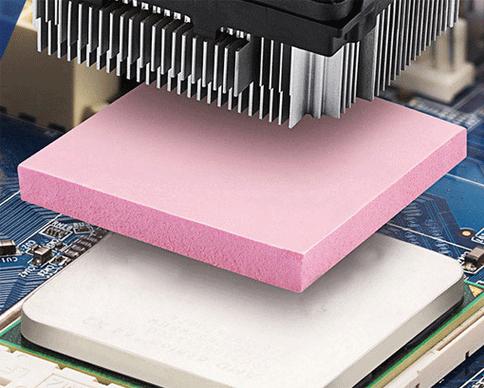
- Phase Change Pad: Our 1.8 W/m·K SP180 pad.
Parameters: Controlled pressure (50 psi), steady-state heat load, and extended thermal cycling (500 cycles, -40°C to 125°C).
Benchmark Results:
- Initial Thermal Resistance:
- Grease: Slightly lower resistance at time zero when perfectly applied (optimal thin layer).
- Pad: Resistance within 5-10% of the optimal grease application.
- Performance After 500 Thermal Cycles (The Key Differentiator):
- Grease: Showed >15% increase in thermal resistance due to pump-out and dry-out. Performance became inconsistent.
- Phase Change Pad: Showed <5% increase in resistance. Material re-solidified consistently, maintaining interfacial contact.
Analysis: The Trade-Off Spectrum
| Factor | Thermal Grease | Phase Change Pad |
|---|---|---|
| Peak Performance | Slightly Higher (if perfectly applied) | Excellent & Consistent |
| Long-Term Stability | Poor (Prone to Pump-Out) | Excellent |
| Ease of Application | Skill-Dependent, Messy | Simple, Clean, Foolproof |
| Re-workability | Easy (but messy to clean) | Easy |
| Process Control | Low (Variability in amount, spread) | High (Pre-defined size/thickness) |
When to Choose Grease: For one-off, high-performance projects (e.g., overclocking benchmarks) where you can meticulously apply and accept eventual degradation, or for irregular surfaces where a pad cannot conform.
When to Choose a Phase Change Pad: For any production environment, reliability-focused design, or when clean, repeatable assembly is required. It provides 95% of the peak performance with 200% of the long-term reliability.
The data is clear: for most industrial and commercial applications, the consistency and durability of a phase change pad deliver a lower total cost of ownership and higher field reliability than even the best thermal grease.